|


MSN SHOPPING |
RESOURCE GUIDE |

| MSNBC Home » Technology & Science » Space News |
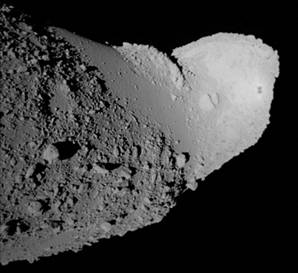 ISAS / JAXA A
picture taken by the Hayabusa probe during its close approach
shows the tip of the asteroid Itokawa. Hayabusa's shadow can be seen
near the asteroid's edge as an I-shaped mark. |
 | Slide show |
  | • Month in space: Cosmic pearls See ghostly moons, a solar eclipse and other highlights from October 2005. |
Most Popular |
| |||||
RSS FEEDS ON MSNBC.COM |
Add these headlines to your news reader • Space News  |
|
"We performed the touchdown test with success," mission managers reported on the Web site of the Japan Aerospace Exploration Agency, or JAXA.
However, Japan's Kyodo news agency quoted space officials as saying that an attempt to send a mini-robot called MINERVA to the asteroid's surface met with failure.
The 1.3 pound (600-gram) MINERVA, whose name stands for Micro/Nano Experimental Robot Vehicle for Asteroid, was designed to hop gently across Itokawa's surface. Three small TV cameras were supposed to take pictures, while temperature sensors would have provided insight into the texture of the soil.
The hopper robot was deployed at 3:24 p.m. Japan time, from a distance of about 180 feet (55 meters). Hayabusa “was able to establish radio contact with the free-flying MINERVA,” according to the JAXA report. But at the later update, officials said the small probe was now expected to drift away from Itokawa and not fall to the surface as planned. Its batteries are expected to be exhausted in a day or two.
On its Japanese-language Web site, JAXA said that "regrettably, as for leaving MINERVA on Itokawa's surface, it seems that it is not possible."
Meanwhile, the Hayabusa mothership has safely returned to its home position, about 4 miles (6.4 kilometers) distant from the asteroid.
Delicate maneuvers
Preliminary indications pointed to a problem with the delicate maneuvers behind MINERVA's deployment.
While awaiting the ground command to deploy MINERVA, the Hayabusa mothership was under autopilot control to maintain a set distance above the surface. As it drifted up or down to a range limit, Hayabusa fired small gas thrusters to stay within the designated interval.
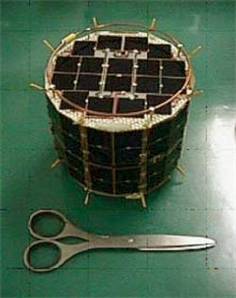 |
ISAS / JAXA The
MINERVA mini-robot is equipped with temperature sensors and three
cameras. A pair of scissors is shown for a size comparison. |
Kyodo quoted Kawaguchi as saying the mission team tried to make sure that the deployment signal would arrive while Hayabusa was descending. For some reason, this did not work.
The asteroid is currently falling inward toward the sun and is crossing Earth’s orbital path, but on the far side of the sun. At that range (about 180 million miles or 290 million kilometers), the travel time for a radio message is 16 minutes each way.
"It is very disappointing that it did not work out nicely," Kawaguchi was quoted as saying. "We found out various things about the asteroid, so we will study the data and hope it will lead to the successful landing of Hayabusa [on Nov. 19]."
Click for related story |
The sample retrieval has always been the main scientific thrust of the project, and observers believe that the disappointment surrounding MINERVA may actually help contribute to a better understanding of the challenge of landing the entire spacecraft successfully next week.
“The apparent loss of Minerva is a disappointment,” Louis Friedman, executive director of the California-based Planetary Society, said in an e-mail message to MSNBC.com, “but it in no way diminishes the admirable mission that JAXA carried out. They are doing something that no one else has tried in space; and the achievements of rendezvous engineering and close-up science are already truly remarkable.”
NBC News space analyst James Oberg spent 22 years at NASA's Johnson Space Center as a Mission Control operator and an orbital designer.

 High
High
MORE FROM SPACE NEWS |
 Space News Section Front |
| ||||