 |
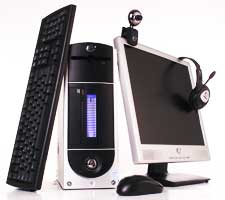
| The Bolivarian computer, model VIT C2660 |
Mérida, June 12, 2007 (venezuelanalysis.com)—
The Venezuelan government of President Hugo Chavez announced the launch
of their "Bolivarian Computers" last week, consisting of four different
models produced in Venezuela with Chinese technology. The new computers
will run the open-source Linux operating system and will first be used
inside the government "missions" and state companies and institutions
but eventually are expected to be sold across Venezuela and Latin
America.
Venezuela’s President Hugo Chavez presented the new
machines to the public last week at an event in the state of Falcon as
he donated them to a school there. The new computers are produced by
the joint venture VIT (Venezuela de Industria Tecnológica), which is
owned by the Chinese company Lang Chao and the Venezuelan Ministry of
Light Industry and Commerce.
"The price of other similar brands
is US$ 930, and the price of our computer is US$ 690, almost 40% less,"
explained President Chavez. "But, in addition, it has an added value,
given that it comes with open-source software and a three year
guarantee, while other brands only offer one year."
Production
of the models began in the end of 2006 and the first 1,619 units were
distributed to students of Integral Medicine in the government program
Mission Sucre. Chavez promised last October to give a computer to every
one of the 11,100 students in the second year of the new medical
education program Integral Community Medicine (MIC) and began to follow
through with that promise last May.
"I feel excited because the
president came through with his promise, and that makes us be more
responsible with the program, more dedicated, since it is a big help
that motivates us to keep moving forward," said one student.
Units
have also been given to the Urban Transportation Fund, the Agrarian
Bank, the national mail service Ipostel, and the Experimental
University of Simon Rodriguez.
And although the first units have
been donated to the public sector, the new Bolivarian computers will
also be sold inside Venezuela and exported.
"We are working
with cooperatives and small companies to form our own distribution
network," said the manager of sales Eduardo Hernandez. "It's a slow
process. This month we have already completed the formation (of a
distribution network) in Caracas and by the end of the year we will
have distribution and technical support throughout the whole country."
The
computer factory is located on the Paraguana Peninsula in the state of
Falcon and has an annual capacity of 150,000 units. For this year the
factory is expected to assemble 80,000 units and 6,000 laptop
computers.
Until now Venezuela has always imported computers
both from well-known brands and generic brands from the developed
world. With this new venture the Venezuelan government hopes to
diversify national production, integrate national productive chains,
and work towards technological independence for the country.
According
to the web page of the new state company, VIT has the objective of
"production, marketing and sale of technological products, with an
emphasis in manufacturing and assembling computers and accessories. Our
efforts are also focused on national export, with a future projection
to the international market."
By the end of the year, the
intention is to begin to locally produce some of the technology in
order to substitute some of the imported components used in the
assembly of the machines for components produced in Venezuela. In order
to do this, the government has built installations for research and
development in order to design the components inside the same factory.
The
company is offering 3 different desktop models and one laptop with a
price range of US$ 405 (Bs. 870,750) to US$ 1,400 (Bs. 3,010,000). The
processors will range in speed from 1.5 GHz to a 3.0 GHz Intel Pentium
IV and the laptop will use a 2.0 GHz Intel Core 2 Duo processor.
With
respect to the operating system, Venezuela has taken a strong position
in favor of open-source software in order to "promote technological
development" and help "reach technological independence." For this
reason the computers will use the open-source Linux, but the components
are also compatible with the Windows operating system.