|


|
Declaration, Ex-dividend And Record Date Defined
November 8, 2002 | By Cory Janssen, Co-Founder, Investopedia.com
Have the workings of dividends
and dividend distributions mystified you too? Chances are it's not the
concept of dividends that confuses you; the ex-dividend date and date
of record are the tricky factors. In this article we'll sort through
the dividend payment process and explain on what date the buyer of the
stock gets to keep the dividend.
Before we explain how it all works, let's go over
some of the basics to ensure we have the proper foundation to
understand the more complex issues. Some investment terms are thrown
around more often than Frisbees on a hot summer day, so it's important
that we define exactly what we're talking about.
Different Types of Dividends
The decision to distribute a dividend is made by a company's board of directors.
There is nothing requiring a company to pay a dividend, even if the
company has paid dividends in the past. However, many investors view a
steady dividend history as an important indicator of a good investment,
so most companies are reluctant to reduce or stop their dividend
payments. For more information on buying dividend paying stocks, see
the articles How Dividends Work for Investors and The Importance of Dividends
Dividends
can be paid in various different forms, but there are two major
categories: cash and stock. The most popular are cash dividends. This
is money paid to stockholders, normally out of the corporation's
current earnings or accumulated profits.
For example, suppose
you own 100 shares of Cory's Brewing Company (ticker: CBC). Cory has
made record sales this year thanks to an unusually high demand for his
unique peach flavored beer. The company therefore decides to share some
of this good fortune with the stockholders and declares a dividend of
$0.10 per share. This means that you will receive a check from Cory's
Brewing Company for $10.00 ($0.10*100). In practice, companies that pay
dividends usually do so on a regular basis of four times a year. A
one-time dividend such as the one we just described is referred to as
an extra dividend.
The stock dividend, the second most common
dividend paying method, pays additional shares rather than cash.
Suppose that Cory's Brewing Company wishes to issue a dividend but
doesn't have the necessary cash available to pay everyone. He does,
however, have enough Treasury stock
to meet the requirements of the dividend payout. So instead of paying
cash, Cory decides to issue a dividend of 0.05 new shares of CBC for
every existing one. This means that you will receive five shares of CBC
for every 100 shares that you own. If any fractional shares are left
over, the dividend is paid as cash (because stocks can't trade
fractionally).
Another type of dividend is the property dividend, but it is used rarely. This type of allocation is a physical transfer of a tangible asset
from the company to the investors. For instance, if Cory's Brewing
Company was still insistent on paying out dividends but didn't have
enough Treasury stock or enough money to pay out all investors, the
company could look for something physical (property) to distribute. In
this case, Cory might decide that his unique peach beer would be the
best substitute, so he could distribute a couple of six-packs to all
the shareholders.
The Important Dates of a Dividend
There are four major dates in the process of a company paying dividends:
- Declaration date–
This is the date on which the board of directors announces to
shareholders and the market as a whole that the company will pay a
dividend.
- Ex-date or Ex-dividend date–
On (or after) this date the security trades without its dividend. If
you buy a dividend paying stock one day before the ex-dividend you will
still get the dividend, but if you buy on the ex-dividend date, you
won't get the dividend. Conversely, if you want to sell a stock and
still receive a dividend that has been declared you need to sell on (or
after) the ex-dividend day. The ex-date is the second business day
before the date of record.
- Date of record–
This is the date on which the company looks at its records to see who
the shareholders of the company are. An investor must be listed as a holder of record to ensure the right of a dividend payout.
- Date of payment (payable date)
– This is the date the company mails out the dividend to the holder of
record. This date is generally a week or more after the date of record
so that the company has sufficient time to ensure that it accurately
pays all those who are entitled.
Why All These Dates?
Ex-dividend
dates are used to make sure dividend checks go to the right people. In
today's market, settlement of stocks is a T+3 process, which means that
when you buy a stock, it takes three days from the transaction date (T)
for the change to be entered into the company's record books.
As
mentioned, if you are not in the company's record books on the date of
record, you won't receive the dividend payment. To ensure that you are
in the record books, you need to buy the stock at least three days
before the date of record, which also happens to be the day before the
ex-dividend date.
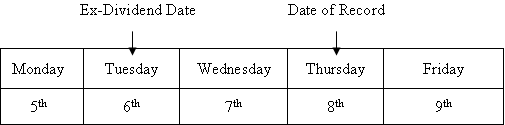
As
you can see by the diagram above, if you buy on the ex-dividend date
(Tuesday), which is only two days before the date of record, you will
not receive the dividend because your name will not appear in the
company's record books until Friday. If you want to buy the stock and
receive the dividend, you need to buy it on Monday. (When the stock is
trading with the dividend the term cum dividend is used). But, if you want to sell the stock and still receive the dividend, you need to sell on or after Tuesday the 6th.
*Note:
Different rules apply if the dividend is 25% or greater of the value of
the security. For further details on dividend issues, search the NASD's website.
| ADVERTISEMENT
Learn
to trade the markets like a Pro! Explore our wide range of FREE offers
including CD-ROMs, Books, Home Study Courses, Software, and even Trade
Recommendations. Click
Here to see the FREE Offers. |
|
A Money Machine?
Now that we understand
that a dividend can be received by purchasing the stock before the
ex-date, can we make more money? Nope, it's not that easy. Remember,
everybody knows when the dividend is going to be paid, and the market
sees the dividend payout as a time when the company is giving out a
part of its profits (reducing its cash). So the price of the stock will
drop approximately by the amount of the dividend on the ex-dividend
date. The word "approximately" is crucial here. Due to tax
considerations and other happenings in the market, the actual drop in
price may be slightly different. In any case, the point is that you
can't make free profits on the ex-dividend date.
Conclusion
The
reasons for and effects of all these dates are by no means easy to
grasp. It's important to clear up any confusion between ex-dividend and
record dates. But always keep in mind that when you're investing in a
dividend paying stock, it's more crucial to consider the quality of the
company than the date on which you buy in.
|
By Cory Janssen, Co-Founder, Investopedia.com
Cory
is one of the founders of Investopedia.com. Aside from his regular
management duties, he serves as Editor of the Investopedia Advisor, our
subscription research service.
|
|
|
|































 •
•


