A
skyscraper’s exterior skin adds structural support and helps maintain
the building’s internal temperature; some skins also offer aesthetic
value, shimmering in the light and reflecting the landscape in pleasing
ways. But what if a skyscraper’s outside wrapping could take a more
active role in sustaining the building’s operational needs and engaging
passers-by?
One result might be PV-TV. Developed last year by the Tokyo-based MSK Corporation in conjunction with chemical company Kaneka
and Japanese architecture firm Taiyo Industries, this amorphous silicon
technology has a “three-in-one” functionality: it is able to act as a
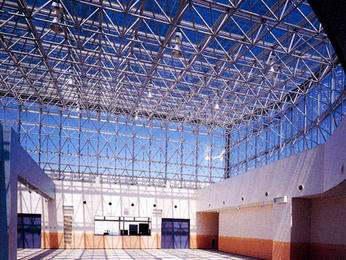
glazing element, solar panel, and video display screen. The panels,
which are 980mm long and 950mm wide, come in a standard depth of 10mm
thick, as well as in a 13mm-thick, strengthened-glass option.
As an external glaze, PV-TV allows up to 10% visible light to be
transmitted through the panel. This level of light transmission is
optimal to allow sufficient light in cloudy conditions while protecting
against excessive solar gain and ultraviolet rays. It can provide
thermal insulation and replace top lights, eaves, windows, and/or
curtain walls.
As a solar photovoltaic (PV) panel, PV-TV can generate 3.8 watts of
electricity per square foot, an above-average level of efficiency.
Furthermore, unlike other PV systems, these panels are transparent and
can be integrated into almost any part of a building without obscuring
light or ruining the building’s aesthetic appearance, two downsides of
conventional PV panels.
But PV-TV’s most unusual feature is its ability to act as a full-color
internal and external screen. A picture or advertisement projected from
inside a structure can be seen within that building, with PV-TV acting
as a regular display screen. On the outside of the building, the
material can function as a giant billboard.
Since the PV-TV screens don’t have the luminosity of liquid crystalline
or a digital TV screen, they perform best when there are no other
competing light sources, according to MSK spokeswoman Aya Tanida.
Currently, there are a few projects within Japan where PV-TV has been
applied. One is MSK’s own factory in Nagano, where various components
of MSK’s solar modules are manufactured. The factory is now the world’s
largest single PV module plant, producing 100 megawatts of energy
annually.
Though PV-TV has yet to gain popularity outside of Japan, MSK still has
high hopes for the global market. The company recently opened an office
in London and says it will heavily market all of its PV products to
European companies.
Could PV-TV have a future in the U.S.? According to Paul Maycock, of PV
Energy Systems, Inc., it is uncertain. One stumbling block is how
difficult it is to quantify the product’s value versus its price.
(Right now, the technology is priced at $45 per square foot.) But that
said, Maycock adds, “Whoever heard of a curtain wall that pays for
itself? It’s a great idea to do something with the skin of the building
besides just keeping the heat load down.”







 BACK TO TOP