




 Nouriel Roubini's Global EconoMonitor
Recent Nightly Business Report PBS Roubini Interview
7/22/09 - Nightly Business Report, PBS - NYU Professor Nouriel Roubini's Outlook on the Economy
Transcript from PBS:
Wednesday, July 22, 2009
SUZANNE PRATT: Joining me now with his thoughts on health care and the economy is Nouriel Roubini. He is the economics professor at NYU's Stern School of Business, who forecasted the housing bubble way before everyone else. Professor Roubini, welcome back to NIGHTLY BUSINESS REPORT.
NOURIEL ROUBINI, ECONOMICS PROF., NYU STERN SCHOOL OF BUSINESS: Pleasure being with you tonight.
PRATT: I want to start with health care. What do you think if there is health care reform and we see something in the near future, it's likely to do to economic recovery in this country?
ROUBINI: We certainly need universal health care but we have to do it in a way that controls the fiscal costs. The new bill might cost $1.5 trillion over the next 10 years and I think it's critical to controlling costs. There are two ways of doing it. One is to make sure that the government negotiates with drug companies are reducing the cost of medicines and the second one is that the system currently gives an incentive to doctors who have too many test and procedures because they're paid based on that. Therefore we have also to control and change that system.
PRATT: So what is your forecast for the recovery right now? I've been hearing sub par growth. What exactly does that mean?
ROUBINI: First of all, in my view the recession is going to continue through the end of the year. It's not over yet, and while potential growth rate for the U.S. economy is 3 percent, I expect that the growth rate of the economy is going to be very anemic, below trend, then on 1 percent for the next two years. Why? You have U.S. consumers are shopped out, saving less debt burden. They're not going to consume very much. Your financial system is severely damaged, and credit growth is going to be limited, and now we have also this massive re-leveraging of the public sector with a large budget deficit and increases in public debt are going to eventually crowd out the economic recovery of the private sector. So I don't see a lot of economic growth ahead of us.
PRATT: Are you worried at all about a double-dip recession?
ROUBINI: Yeah, the risk is that by the end of the next year, if budget deficit remains very large, around $1.5 trillion, and if the Fed keep on monetizing them, essentially printing money to try to prevent increases in interest rates, expect that the inflation is going to go up, and if expecting inflation were to go up, long-term government bond yields would go up, and mortgage rates will go up. Borrowing costs for consumers (INAUDIBLE) will go up, and that's going to crowd out the recovery, so there's even a risk of a double-dip recession.
PRATT: How great a risk would you expect? I mean is there a percentage that you'd be willing to put it at?
ROUBINI: Well, that's going to depend on the decisions that are going to be made about exit strategies from these massive monetary easing and massive fiscal easing. It's going to be difficult because if you reduce the fiscal stimulus too much too soon, raising taxes, cut spending, the economy is weak, is going to tip into recession. If you wait too long and the deficit remains too large, then eventually the market's going to worry about rising inflation, rising deficits (INAUDIBLE) rates are going to go up, and you'll have recession again. So the timing and the sequencing and when to do it is going to be a very difficult policy proposition.
PRATT: If your economic projections are correct and I have to point out that they are below consensus, it would seem that the stock market may have gotten way ahead of itself here at the current levels. Do you agree with that?
ROUBINI: Yes. Some increase in stock prices are justified because we avoided the risk of a near depression. That was the risk we were facing in the first quarter. But markets have gone up too much, too soon based on economic fundamentals. If the recovery is going to be weaker, therefore profits are not going to recover as fast. If you are going to have still weaknesses in the rest of the world, Europe, Japan I think there will be downside risk for the stock market from this point on.
PRATT: So what are you looking with your money? Are you looking overseas or are you still looking for U.S. equities to do the best?
ROUBINI: Well, for the time being, I keep my money still in cash, because I think there are downside risk on equities, on credit, on foreign equities, on commodities. I think that there are downside risks, too many risky assets. It's better to wait until there are stronger signs of a more robust and resilient recovery before jumping into risky assets.
PRATT: What would you expect those stronger signs to be? What do you look for?
ROUBINI: Well, we have to look whether there's going to be any stabilization of the job market, but unfortunately I see unemployment rate well above 10 percent this year and close to 11 percent at the peak next year. We have to see a recovery of the U.S. consumer, but there's a massive weakness because of consumers being hit by default (ph) in the equity wealth, in this housing wealth, falling labor income, rising debt and debt servicing ratio (ph). That's why I'm somehow bearish about the recovery and don't expect the recovery to occur anytime soon and that's going to be a negative for the markets.
PRATT: OK, some very interesting thoughts from you. Thank you very much for joining us.
ROUBINI: Pleasure being with you.
PRATT: My guest this evening Professor Nouriel Roubini.
For the video click HERE

Nightly Business Report, PBS: Health Care Reform Costs in Question
Interview with Nouriel: 4:15 - 9:03
The Road Ahead for the Global Economy
The global recession may end towards the end of 2009 rather than sooner and the global recovery in 2010 will be anemic and well below trend as leveraged and income/profit-challenged households, firms and financial institutions are constrained in their ability to borrow, lend and spend. Meanwhile a perfect storm of...
Recent CNBC Roubini Interview
7/20/09 - CNBC - Roubini: Economic Recovery to be 'Very Ugly' (Click here for video)
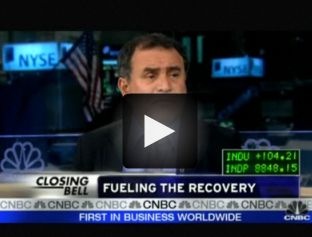
Nouriel Roubini, the economist whose dire forecasts earned him the nickname "Doctor Doom", told CNBC Monday that the economic recovery is going to be "very ugly."
"The recovery is going to be subpar," Roubini said. "I see a one percent growth in the economy in the next few years. There will also be 11 percent unemployment next year and the recovery is going to be slow. It's going to feel like a recession even when it ends."
Asked about his comments in a speech last week about the recession ending in 2009, Roubini said, "I've been saying all along the recession is going to last 24 months. It started in December of 2007 and my view is that it won't be over until December of this year."
Roubini has said those comments were taken out of context. Several business news outlets, picking up on a report initially from Reuters, cited Roubini as saying that the worst of the economic financial crisis may be over.
When asked about the economy Monday, Roubini said, "We may be out of a freefall for the financial system," said Roubini. "We have seen the worst in that sense. But in my view there is a sluggish U shaped recovery that might go into a W double dip if we don't fix the problems in the economy."
Other comments from Roubini:
On a second stimulus: "I think there will be another one toward the end of the year. We need to have more shovel ready labor intensive infrastructure projects. We'll need it."
On investing in today's markets: "A "Stay away from risky assets. I think from now on the surprise will be on the downside in areas like commodities."
On which country exits the global recession first: "The U.S. should be the first, but emerging markets do have some movement."
© 2009 CNBC.com
Roubini Statement on the U.S. Economic Outlook
“It has been widely reported today that I have stated that the recession will be over 'this year' and that I have 'improved' my economic outlook. Despite those reports - however – my views expressed today are no different than the views I have expressed previously. If anything my views were taken out of context.
“I have said on numerous occasions that the recession would last roughly 24 months. Therefore, we are 19 months into that recession. If, as I predicted, the recession is over by the end of the year, it will have lasted 24 months with a recovery only beginning in 2010. Simply put I am not forecasting economic growth before year’s end.
“Indeed, last year I argued that this will be a long and deep and protracted U-shaped recession that would last 24 months. Meanwhile, the consensus argued that this would be a short and shallow V-shaped eight-month long recession (like those in 1990-91 and 2001). That debate is over today as we are in the 19th month of a severe recession; so the V is out the window and we are in a deep U-shaped recession. If that recession were to be over by year end – as I have consistently predicted – it would have lasted 24 months and thus been three times longer than the previous two and five times deeper – in terms of cumulative GDP contraction – than the previous two. So, there is nothing new in my remarks today about the recession being over at the end of this year.
“I have also consistently argued – including in my remarks today - that while the consensus is that the U.S. economy will go back close to potential growth by next year, I see instead a shallow, below-par and below-trend recovery where growth will average about 1% in the next couple of years when potential is probably closer to 2.75%.
“I have also consistently argued that there is a risk of a double-dip W-shaped recession toward the end of 2010, as a tough policy dilemma will emerge next year. On one side, early exit from monetary and fiscal easing would tip the economy into a new recession as the recovery is anemic and deflationary pressures are dominant. On the other side, maintaining large budget deficits and continued monetization of such deficits would eventually increase long-term interest rates (because of concerns about medium-term fiscal sustainability and because of an increase in expected inflation), thus leading to a crowding out of private demand.
“While the recession will be over by the end of the year the recovery will be weak given the debt overhang in the household sector, the financial system and the corporate sector. Now there is also a massive re-leveraging of the public sector with unsustainable fiscal deficits and public debt accumulation.
“Also, as I fleshed out in detail in recent remarks the labor market is still very weak. I predict a peak unemployment rate of close to 11% in 2010. Such a large unemployment rate will have negative effects on labor income and consumption growth; will postpone the bottoming out of the housing sector; will lead to larger defaults and losses on bank loans (residential and commercial mortgages, credit cards, auto loans, leveraged loans); will increase the size of the budget deficit (even before any additional stimulus is implemented); and will increase protectionist pressures.
“So, yes there is light at the end of the tunnel for the U.S. and the global economy. But as I have consistently argued, the recession will continue through the end of the year, and the recovery will be weak and at risk of a double-dip, as the challenge of getting right the timing and size of the exit strategy for monetary and fiscal policy easing will be daunting.
“RGE Monitor will soon release our updated U.S. and Global Economic Outlook. A preview of the U.S. Outlook is available on our website: www.rgemonitor.com”
Mounting Job Losses Will Hurt Consumption, Housing, Banks’ Balance Sheets, Public Finances and Lead to Protectionist Pressures
Recent data suggest that job market conditions are not improving in the United States and other advanced economies. In the U.S., the unemployment rate, currently at 9.5%, is poised to rise above 10% by the fall. It should peak at 11% some time in 2010 and remain well above 10% for a long time. The unemployment rate will peak above 10% in most other advanced economies (especially Europe and Japan), too, where social safety nets are broader and thus leading to less short term job losses and pain, but where the effects of the crisis on growth have been even more severe than the U.S.
But these raw figures on job losses, bad as they are, actually understate the weakness in world labor markets. If you include partially employed workers and discouraged workers who left the U.S. labor force, for example, the unemployment rate is already 16.5%; even temporary employment is sharply down. Monetary and fiscal stimulus in most countries has done little to slow down the rate of job losses as economies suffer from problems of insolvency, not just illiquidity, and as the fiscal stimulus programs are too small and not labor intensive enough. As a result, total labor income – the product of jobs times hours worked times average hourly wages – has fallen dramatically.
Moreover, many employers, seeking to “share the pain” of the recession and slow down the rate of layoffs, are now asking workers to accept cuts in both hours and hourly wages. Thus, the total effect of the recession on labor income of jobs, hours and wage reductions is much larger.
Other indicators are suggesting a protracted period of job losses and a persistently high unemployment rate even after the recession is over. The average duration of unemployment is not at an all time high in the U.S. Many manufacturing sectors are on a secular decline (autos, etc.) and employers are shedding jobs on a permanent basis; employment in the previously bubbly sectors (housing and related housing/real estate services, banking and financial services) is falling sharply and will not recover for a long time. The process of offshore outsourcing of both blue collar and white collar jobs is still in full swing. A lot of the job losses in the U.S. and in other advanced economies are structural rather than cyclical; many jobs will never come back.
A sharp contraction in jobs and labor income has many negative consequences on both the economy and financial markets. There are at least five important ones that we will discuss next:
Roubini on a Bloomberg Panel: Recession will Last Another Six Months and the Recovery will be Shallow
7/9/09 - Bloomberg - Roubini Says U.S. Recession Will Last Six More Months (Click here for video)

July 9 (Bloomberg) -- Nouriel Roubini, a professor at New York University's Stern School of Business, and Robert Shiller, chief economist at MacroMarkets LLC and an economics professor at Yale University, talk with Bloomberg's Tom Keene and Ken Prewitt about the outlook for the U.S. economy.
The economy contracted by 5.5 percent in the first quarter and 6.3 percent in the fourth quarter of 2008, the most since 1958, according to data compiled by Bloomberg. (Source: Bloomberg)
00:00 Outlook for the U.S. economy, recession
07:07 Reasons for current economic condition
11:50 Unemployment rate; fiscal consolidation
18:29 Case-Shiller Index; green shoots in housing
30:05 Second stimulus package; consumer spending
34:43 Roubini, Shiller respond to questions.
Running time 53:52
_______________________
Check out the following reports produced from the panel discussion:
Roubini Sees Six More Months of Recession, ‘Shallow’ Recovery
Lost ‘Animal Spirits’ Worsen Economy, Roubini Says (Update1)
RGE Monitor – U.S. Economic Outlook: Q2 2009 Update
Greetings from RGE Monitor!
The first half of 2009 has ended and we at RGE Monitor are in the process of updating our quarterly Global Economic Outlook. Below you will find a preview of our views on the short-to-medium term prospects for the U.S. economy. The full version of the RGE U.S. economic outlook (available for RGE Premium subscribers) will include analysis on:
- U.S. Consumer Comeback?
- Is the U.S. Housing Sector Stabilizing?
- U.S. Commercial Real Estate the Next Shoe to Drop?
- U.S. Industrial Production and Investment in a Severe Downturn
- U.S. Exports Under Pressure
- U.S. Labor Market Pain Continues
- Fiscal Stimulus Provides Inadequate Stimulus
- Ballooning U.S. Fiscal Deficit Raises Concerns
- Fed Too Soon to Exit Easing Mode, but Time to Talk About It
- Inflation Pressures Not in Sight Quite Yet
- U.S. Treasuries
- U.S. Dollar
- Structural Weaknesses Will Constrain the U.S. Economic Recovery
The RGE Monitor Global Economic Outlook presents analysis on over 70 countries and several global crucial issues. Specifically, in this Q2 update, our analysts cover trade and protectionism, risks of rising fiscal deficits around the world, global imbalances and climate change, among other issues. The RGE Monitor Global Economic Outlook will be available soon to RGE Premium subscribers.
Now back to our U.S. preview.
New Monthly Roubini Column for Project Syndicate
For the last year, Bob Shiller and I have been alternating each month in writing a column for Project Syndicate (a syndication service that published such columns in hundreds of newspapers around the world). I am now contributing to this column – entitled “After the Storm” - on a monthly basis. My latest column was written in about a month ago in mid-June when asset markets – equities, credit and commodities – were still bubbly and rallying as they had been since March 9th.
I pointed out in that column that markets had moved up too fast too soon relative to market fundamentals and that a significant correction of this bear market rally was likely to occur soon as the alleged green shoots would likely turn into yellow weeds. Since then U.S. and global equity markets – including in emerging market economies – have started to head south; oil and other commodity prices have started to fall; credit spreads have started to widen again; and emerging markets equity markets have corrected more than those of advanced economies. Indeed the excessive optimism about spring green shoots have shown them to be mostly summer yellow weeds that may actually turn into brown manure by late 2010 after a minor economic recovery in the first half of 2010. Indeed, the June US employment report last week has brought back a reality check after the misplaced euphoria of the second quarter.
For those of you who missed this column a month ago here it is in full text:
Financial Gain, Economic Pain
June 15th, 2001 NEW YORK – In the past three months, global asset prices have rebounded sharply: stock prices have increased by more than 30% in advanced economies, and by much more in most emerging markets. Prices of commodities – oil, energy, and minerals – have soared; corporate credit spreads (the difference between the yield of corporate and government bonds) have narrowed dramatically, as government-bond yields have increased sharply; volatility (the “fear gauge”) has fallen; and the dollar has weakened, as demand for safe dollar assets has abated.
But is the recovery of asset prices driven by economic fundamentals? Is it sustainable? Is the recovery in stock prices another bear-market rally or the beginning of a bullish trend?
While economic data suggests that improvement in fundamentals has occurred - the risk of a near depression has been reduced; the prospects of the global recession bottoming out by year end are increasing; and risk sentiment is improving - it is equally clear that other, less sustainable factors are also playing a role. Moreover, the sharp rise in some asset prices threatens the recovery of a global economy that has not yet hit bottom. Indeed, many risks of a downward market correction remain.
First, confidence and risk aversion are fickle, and bouts of renewed volatility may occur if macroeconomic and financial data were to surprise on the downside – as they may if a near-term and robust global recovery (which many people expect) does not materialize.
Second, extremely loose monetary policies (zero interest rates, quantitative easing, new credit facilities, emissions of government bonds, and purchases of illiquid and risky private assets), together with the huge sums spent to stabilize the financial system, may be causing a new liquidity-driven asset bubble in financial and commodity markets. For example, Chinese state-owned enterprises that gained access to huge amounts of easy money and credit are buying equities and stockpiling commodities well beyond their productive needs.
The risk of a correction in the face of disappointing macroeconomic fundamentals is clear. Indeed, recent data from the United States and other advanced economies suggest that the recession may last through the end of the year. Worse, the recovery is likely to be anemic and sub-par – well below potential for a couple of years, if not longer – as the burden of debts and leverage of the private sector combine with rising public sector debts to limit the ability of households, financial firms, and corporations to lend, borrow, spend, consume, and invest.
This more challenging scenario of anemic recovery undermines hopes for a V-shaped recovery, as low growth and deflationary pressures constrain earnings and profit margins, and as unemployment rates above 10% in most advanced economies cause financial shocks to re-emerge, owing to mounting losses for banks’ and financial institutions’ portfolios of loans and toxic assets. At the same time, financial crises in a number of emerging markets could prove contagious, placing additional stress on global financial markets.
The increase in some asset prices may, moreover, lead to a W-shaped double-dip recession. In particular, thanks to massive liquidity, energy prices are now rising too high too soon. The role that high oil prices played in the summer of 2008 in tipping the global economy into recession should not be underestimated. Oil above $140 a barrel was the last straw – coming on top of the housing busts and financial shocks – for the global economy, as it represented a massive supply shock for the US, Europe, Japan, China and other net importers of oil.
Meanwhile, rising fiscal deficits in most economies are now pushing up the yields of long-term government bonds. Some of the rise in long rates is a necessary correction, as investors are now pricing a global recovery. But some of this increase is driven by more worrisome factors: the effects of large budget deficits and debt on sovereign risk, and thus on real interest rates; and concerns that the incentive to monetize these large deficits will lead to high inflation after the global economy recovers in 2010-11 and deflationary forces abate. The crowding out of private demand, owing to higher government-bond yields – and the ensuing increase in mortgage rates and other private yields – could, in turn, endanger the recovery.
As a result, one cannot rule out that by late 2010 or 2011, a perfect storm of oil above $100 a barrel, rising government-bond yields, and tax increases (as governments seek to avoid debt-refinancing risks) may lead to a renewed growth slowdown, if not an outright double-dip recession.
The recent recovery of asset prices from their March lows is in part justified by fundamentals, as the risks of global financial meltdown and depression have fallen and confidence has improved. But much of the rise is not justified, as it is driven by excessively optimistic expectations of a rapid recovery of growth towards its potential level, and by a liquidity bubble that is raising oil prices and equities too fast too soon. A negative oil shock, together with rising government-bond yields – could clip the recovery’s wings and lead to a significant further downturn in asset prices and in the real economy.
U.S. Job Report Suggests that Green Shoots are Mostly Yellow Weeds
The June employment report suggests that the alleged ‘green shoots’ are mostly yellow weeds that may eventually turn into brown manure. The employment report shows that conditions in the labor market continue to be extremely weak, with job losses in June of over 460,000. With the current rate of job losses, it is very clear that the unemployment rate could reach 10 percent by later this summer, around August or September, and will be closer to 10.5 percent if not 11 percent by year-end. I expect the unemployment rate is going to peak at around 11 percent at some point in 2010, well above historical standards for even severe recessions.
It’s clear that even if the recession were to be over anytime soon – and it’s not going to be over before the end of the year – job losses are going to continue for at least another year and a half. Historically, during the last two recessions, job losses continued for at least a year and a half after the recession was over. During the 2001 recession, the recession was over in November 2001, and job losses continued through August 2003 for a cumulative loss of jobs of over 5 million; this time we are already seeing more than 6 million job losses and the recession is not over.
The details of the unemployment report are even worse than the headline. Not only are there large job losses right now, but as a way of sharing the pain, firms are inducing workers to reduce hours and hourly wages. Therefore, when we’re looking at the effect of the labor market on labor income, we should consider that the total value of labor income is the product of jobs, hours, and average hourly wages – and that all three elements are falling right now. So the effect on labor income is much more significant than job losses alone.
The details also suggest that other aspects of the labor markets are worsening. If you include discouraged workers and partially-employed workers, the unemployment rate is already above 16 percent. If you consider also that temporary jobs are falling now quite sharply, labor market conditions are becoming worse. And the average duration of unemployment now is at an all-time high. So people not only are losing jobs, but they’re finding it harder to find new jobs. So every element of the labor market is worsening.
The unemployment rate rose only marginally from 9.4 percent to 9.5 percent, but that’s because so many people are discouraged that they exited the labor force voluntarily, and therefore are not counted in the official unemployment rate.
The other element of the report that must be considered is that, for the summer, the Bureau of Labor Statistics (BLS) is still adding between 150,000 and 200,000 jobs based on the birth/death model. We know the distortions of the birth/death model – that in a recession jobs created within firms are much smaller than those created by firms that are dying. So that’s distorting downward the number of job losses. Based on the initial claims for unemployment benefits, it’s more likely that the job losses are closer to 600,000 per month rather than the figures officially reported.
These job losses are going to have a significant effect on consumer confidence and consumption in the months ahead. We’ve also seen extreme weakness in consumption. There was a boost in retail sales and real personal consumption-spending in January and February, sparked by sales following the holiday season, but the numbers from April, May, and now June are extremely weak in real terms. In April and May you saw a significant increase in real personal income only because of tax rebates and unemployment benefits. In April, there was a sharp fall in real personal spending, and in May the increase was only marginal in real terms.
This suggests that the most of the tax rebates are being saved rather than consumed. The same thing happened last year. Last year, with a $100 billion tax rebate, only thirty cents on the dollar were spent while seventy cents on the dollar were saved. Last year, people expected the tax rebate to stimulate consumption through September. Instead, there was an increase in April, May, and June, with the increase fizzling out by July.
This year it’s even worse. We have another $100 billion in tax rebates in the pipeline. But the numbers suggest that in April, real consumption fell. And in May it was practically flat. So this year households are even more worried than they were last year about jobs, income, credit cards and mortgages. Most likely only around 20 cents on the dollar – rather than 30 cents last year – of that increase of income is going to be spent. In any case, that increase in income is just temporary and is going to fizzle out by the summer. So you can expect a significant further reduction in consumption in the fall after the effects of the tax rebates fade.
The other important aspect of the labor market is that if the unemployment rate is going to peak around 11 percent next year, the expected losses for banks on their loans and securities are going to be much higher than the ones estimated in the recent stress tests. You plug an unemployment rate of 11 percent in any model of loan losses and recovery rates and you get very ugly losses for subprime, near-prime, prime, home equity loan lines, credit cards, auto loans, student loans, leverage loans, and commercial loans – much bigger numbers than what the stress tests projected.
In the stress tests, the average unemployment rate next year was assumed to be 10.3 percent in the most adverse scenario. We’ll be already at 10.3 percent by the fall or the winter of this year, and certainly well above that and close to 11% at some point next year.
So these very weak conditions in the labor market suggest problems for the U.S. consumer, but also significant increasing problems for the banking system as these sharp increases in job losses lead to further delinquencies on loans and securities and lower than expected recovery rates.
The latest figures – published this week - on mortgage delinquencies and foreclosures suggest a spike not only in subprime and near-prime delinquencies, but now also on prime mortgages. So the problems of the economy are significantly affecting the banking system. Even if for a couple of other quarters banks are going to use the new Financial Accounting Standards Board (FASB) rules and under-provisioning for loan losses to report better-than-expected results, by Q4, with unemployment rates above 10 percent, that short-term accounting fudging will have a significant impact on reported earnings. And this will show the underlying weakness in the economy. So banks may fudge it for a couple of other quarters, but eventually the effects of very sharp unemployment rates and still sharply falling home prices are going to drag down earnings and have a sharp effect on losses and capital needs of the banks and of the entire financial system.
Essentially, the results today suggested that there are not as many green shoots. These green shoots, as we’ve argued, are mostly yellow weeds that may even turn into brown manure if a double dip W-shaped recession occurs in 2010-2011. And it’s not just the employment situation. Real consumption and retail sales remain weak. Industrial production remains weak. The housing market, in terms of price adjustment, remains weak, even if the quantities - demand and supply - may be closer to bottoming out. Indeed, the inventory of unsold new homes is so large that you could stop producing new homes for almost a year to get rid of that inventory. Moreover, about 50% of existing home sales are distressed sales (short sales and foreclosed homes).
The labor market conditions may have a significant effect on how long it takes for the housing market to bottom out. It’s already estimated that by the end of this year, there will be about 8.4 million people who have a mortgage who have lost jobs, and therefore have essentially little income. Therefore, the number of people who will have difficulties servicing their mortgages is going to rise very sharply.
Home prices have already fallen from their peak by about 30 percent. Based on our analysis, they are going to fall by at least 40 percent from their peak, and more likely 45 percent, before they bottom out. They are still falling at an annualized rate of over 18 percent. That fall of at least 40-45% percent of home prices from their peak is going to imply that about half of all households that have a mortgage – about 25 million of the 51 million that have mortgages – are going to be underwater with negative equity in their homes, and therefore will have a significant incentive to just walk away from their homes.
The job market report is essentially the tip of the iceberg. It’s a significant signal of the weaknesses in the economy. It affects consumer confidence. It affects labor income. It affects consumption. It affects the willingness of firms to start increasing production. It has significant consequences of the housing market. And it has significant consequences, of course, on the banking system.
Overall, it’s an extremely weak report and suggests that weakness in the labor markets is going to continue, and that the recession is more likely to continue through the end of the year and the beginning of next year. It also suggests that recovery will be anemic, subpar, below trend. We are still estimating that U.S. growth next year is going to be 1 percent above the 2009 level, well below a potential growth rate of 3 percent. This is because there is little deleveraging of households, corporate firms and financial institutions while there is a massive re-leveraging of the public sector with sharply rising deficits and debts as many of the private losses have been socialized.
There are also signs that there may be forces leading to a double-dip recession, sometime toward the second half of next year or towards 2011. If oil prices rise too much, too fast, too soon, that’s going to have a negative effect on trade and real disposable income in oil-importing countries (US, Europe, Japan, China, etc.). Also concerns about unsustainable budget deficits are high and are going to remain high, with growth anemic and unemployment rising. These deficits are already pushing long-term interest rates higher as investors worry about medium- to long-term stability. If these budget deficits are going to continue to be monetized, eventually, toward the end of next year, you are going to have a sharp increase in expected inflation - after three years of deflationary pressures - that’s going to push interest rates even higher.
For the time being, of course, there are massive deflationary pressures in the economy: the slack in the goods markets, with demand falling relative to supply-and-excess capacity. The rising slack in labor markets, which are controlling wages and labor costs and pushing them down, implies that deflationary pressures are going to be dominant this year and next year.
But eventually, large budget deficits and their monetization are going to lead – towards the end of next year and in 2011 – to an increase in expected inflation that may lead to a further increase in ten-year treasuries and other long-term government bond yields, and thus mortgage and private-market rates. Together with higher oil prices driven up in part by this wall of liquidity rather than fundamentals alone, this could be a double whammy that could push the economy into a double-dip or W-shaped recession by late 2010 or 2011. So the outlook for the US and global economy remains extremely weak ahead. The recent rally in global equities, commodities and credit may soon fizzle out as an onslaught of worse- than-expected macro, earnings and financial news take a toll on this rally, which has gotten way ahead of improvement in actual macro data.
The Chinese Proposal for a New Global Super Currency
As I discussed a few weeks ago in a New York Times op-ed the Chinese are flexing their muscles on the question of the global reserve currency system dominated by the dollar.
With the revision of the SDR basket (so far including only dollar, euro, yen and pound) coming to the table next year it is clear that the Chinese will push for including the renminbi in the new SDR basket. And senior Brazilian policy sources suggest in private that, if the RMB is included in the SDR, so should the Brazilian Real as there is already a much deeper bond market for Real debt and as - unlike China - Brazil has a more liberalized capital account. And the Russians are now openly pushing for commodity currencies - the Canadian and Australian dollar but also the Ruble - to be included in the SDR basket. And the BRICs are on record pushing for the IMF to issue SDR denominated debt.
So the process that will lead - in the medium-long term - to a challenge of the US dollar as the major global reserve currency has started. The US creditors - the BRICs, the Gulf states and others - are becoming increasingly alarmed that the US will deal with its unsustainable fiscal path via inflation and debasement of the value of the dollar via depreciation. So they will not sit idly waiting for this to happen: they are already diversifying into gold, into resources (as China purchases mines and energy, mineral and commodity resources all over the world) and into shorter term maturity US Treasuries that have less market risk than longer term Treasuries. With two-thirds of US Treasuries, being held by non-residents and the average maturity of such government debt down to 4.5 years, the risk of a refinancing crisis and disorderly fall in the dollar will increase over time unless the US presents a credible plan for medium term fiscal consolidation.
Increasingly it is clear that unless such reduction in fiscal deficits occurs the incentive to continue monetizing them will increase. In the short run such massive monetization has not been inflationary as money velocity has collapsed and as the slack in goods and labor markets is still rapidly rising. But over time - late 2010 and 2011 - deflationary pressures will lead to an increase in expected inflation and then in actual inflation if monetization of persistently large fiscal deficits continues. Indeed some in the US argue that wiping out the real value of public debt and dealing with the private sector debt deflation through a bout of double digit inflation may be the most desirable way to reduce the overhang of public and private debt. While such arguments have many flaws as inflation will have serious collateral damage one cannot rule out that the US will use inflation and depreciation as a way out of its public and private debts. Greenspan's concerns about the long term inflationary effects of large US budget deficits - expressed today in a FT op-ed - go along the same lines. Thus, our creditors' nervousness about the eventual debasement of the US dollar has some increasing validity.
And here again is the full text of my recent NYT op-ed in case you missed it the first time:
From The New York Times:
THE ALMIGHTY RENMINBI?
By Nouriel Roubini
May 13, 2009
THE 19th century was dominated by the British Empire, the 20th century by the United States. We may now be entering the Asian century, dominated by a rising China and its currency. While the dollar status as the major reserve currency will not vanish overnight, we can no longer take it for granted. Sooner than we think, the dollar may be challenged by other currencies, most likely the Chinese renminbi. This would have serious costs for America, as our ability to finance our budget and trade deficits cheaply would disappear.
Traditionally, empires that hold the global reserve currency are also net foreign creditors and net lenders. The British Empire declined and the pound lost its status as the main global reserve currency when Britain became a net debtor and a net borrower in World War II. Today, the United States is in a similar position. It is running huge budget and trade deficits, and is relying on the kindness of restless foreign creditors who are starting to feel uneasy about accumulating even more dollar assets. The resulting downfall of the dollar may be only a matter of time.
But what could replace it? The British pound, the Japanese yen and the Swiss franc remain minor reserve currencies, as those countries are not major powers. Gold is still a barbaric relic whose value rises only when inflation is high. The euro is hobbled by concerns about the long-term viability of the European Monetary Union. That leaves the renminbi.
China is a creditor country with large current account surpluses, a small budget deficit, much lower public debt as a share of G.D.P. than the United States, and solid growth. And it is already taking steps toward challenging the supremacy of the dollar. Beijing has called for a new international reserve currency in the form of the International Monetary Fund special drawing rights (a basket of dollars, euros, pounds and yen). China will soon want to see its own currency included in the basket, as well as the renminbi used as a means of payment in bilateral trade.
At the moment, though, the renminbi is far from ready to achieve reserve currency status. China would first have to ease restrictions on money entering and leaving the country, make its currency fully convertible for such transactions, continue its domestic financial reforms and make its bond markets more liquid. It would take a long time for the renminbi to become a reserve currency, but it could happen. China has already flexed its muscle by setting up currency swaps with several countries (including Argentina, Belarus and Indonesia) and by letting institutions in Hong Kong issue bonds denominated in renminbi, a first step toward creating a deep domestic and international market for its currency.
If China and other countries were to diversify their reserve holdings away from the dollar, and they eventually will, the United States would suffer. We have reaped significant financial benefits from having the dollar as the reserve currency. In particular, the strong market for the dollar allows Americans to borrow at better rates. We have thus been able to finance larger deficits for longer and at lower interest rates, as foreign demand has kept Treasury yields low. We have been able to issue debt in our own currency rather than a foreign one, thus shifting the losses of a fall in the value of the dollar to our creditors. Having commodities priced in dollars has also meant that a fall in the dollar value doesn't lead to a rise in the price of imports.
Now, imagine a world in which China could borrow and lend internationally in its own currency. The renminbi, rather than the dollar, could eventually become a means of payment in trade and a unit of account in pricing imports and exports, as well as a store of value for wealth by international investors. Americans would pay the price. We would have to shell out more for imported goods, and interest rates on both private and public debt would rise. The higher private cost of borrowing could lead to weaker consumption and investment, and slower growth.
This decline of the dollar might take more than a decade, but it could happen even sooner if we do not get our financial house in order. The United States must rein in spending and borrowing, and pursue growth that is not based on asset and credit bubbles. For the last two decades America has been spending more than its income, increasing its foreign liabilities and amassing debts that have become unsustainable. A system where the dollar was the major global currency allowed us to prolong reckless borrowing.
Now that the dollar position is no longer so secure, we need to shift our priorities. This will entail investing in our crumbling infrastructure, alternative and renewable resources and productive human capital, rather than in unnecessary housing and toxic financial innovation. This will be the only way to slow down the decline of the dollar, and sustain our influence in global affairs.
Nouriel Roubini is a professor of economics at the New York University Stern School of Business and the chairman of an economic consulting firm.


For Premium Subscribers
Nouriel Roubini and RGE's team of economists
look at what's ahead for Q3 and beyond.
Listen to the conference call with our Advisory
clients recorded on Tuesday, July 21, 2009.
Stay tuned for the 2009/10 RGE Global
Economic Outlook - Q3 and Beyond available
for download next week.
Interested in becoming a premium subscriber? Call your account representative or contact us at info@rgemonitor.com
- Recent Nightly Business Report PBS Roubini Interview by Nouriel Roubini
2009-07-23 15:11:12 - The Road Ahead for the Global Economy by Nouriel Roubini
2009-07-23 11:20:24 - Recent CNBC Roubini Interview by Nouriel Roubini
2009-07-21 12:34:59 - Roubini Statement on the U.S. Economic Outlook by Nouriel Roubini
2009-07-16 16:56:42 - Mounting Job Losses Will Hurt Consumption, Housing, Banks’ Balance Sheets, Public Finances and Lead to Protectionist Pressures by Nouriel Roubini
2009-07-14 09:55:03 - Roubini on a Bloomberg Panel: Recession will Last Another Six Months and the Recovery will be Shallow by Nouriel Roubini
2009-07-10 15:27:32 - RGE Monitor – U.S. Economic Outlook: Q2 2009 Update by Christian Menegatti
2009-07-08 08:53:20 - New Monthly Roubini Column for Project Syndicate by Nouriel Roubini
2009-07-08 00:09:22 - U.S. Job Report Suggests that Green Shoots are Mostly Yellow Weeds by Nouriel Roubini
2009-07-02 14:04:27 - The Chinese Proposal for a New Global Super Currency by Nouriel Roubini
2009-06-26 12:51:01 - Dr. Doom Has Some Good News by Nouriel Roubini
2009-06-25 10:04:19 - Recent Bloomberg Roubini Interview by Nouriel Roubini
2009-06-24 16:30:49 - Recent CNBC Roubini Interview (Paris) by Nouriel Roubini
2009-06-22 19:10:23 - New Roubini Project Syndicate Op-Ed Pondering on the Financial Markets Rally by Nouriel Roubini
2009-06-21 15:13:44 - Recent YAHOO! Finance Tech Ticker Roubini Interviews by Nouriel Roubini
2009-06-19 14:56:24
-
 2009
2009
-
2008
-
2007
-
2006
-
2005
-
2004
How to Repair a Failed System
An Independent View
From NYU Stern
A Bird's-Eye View—The
Financial Crisis of 2007-2009: Causes and Remedies
by Viral V. Acharya, Thomas Phillipon, Matthew Richardson
and Nouriel Roubini
by the Reinventing Bretton Woods Committee
Download the ebook