The Battle of Wanat | Inside the Wire
'Almost a Lost Cause'
One of the deadliest attacks of the Afghan war is a symbol of the U.S. military's missteps.
Interactive Graphic
The Battle of WanatThis audio and video timeline chronicles the battle from the perspective of a lieutenant killed in the fight, Jonathan Brostrom, and his father, who has sought answers to what went wrong. TOOLBOX
   Resize Resize
  COMMENT
 Discussion Policy
 CLOSE CLOSE
Comments that include profanity or personal attacks or other
inappropriate comments or material will be removed from the site.
Additionally, entries that are unsigned or contain "signatures" by
someone other than the actual author will be removed. Finally, we will
take steps to block users who violate any of our posting standards,
terms of use or privacy policies or any other policies governing this
site. Please review the full rules governing commentaries and discussions. You are fully responsible for the content that you post.
Who's Blogging  |
 Why Do I Have to Log In Again?
 Discussion Policy
Sunday, October 4, 2009
The rocket-propelled grenade and rifle fire was so intense that most of the soldiers spent the opening minutes of the battle lying on their stomachs, praying that the enemy would run out of ammunition.
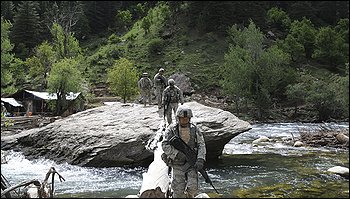
They had been in the tiny Afghan village of Wanat, near the Pakistani border, for four days. The command post of their remote base was still just a muddy hole surrounded by sandbags.
The radio crackled. About 50 yards from the base's perimeter, nine U.S. soldiers manning an observation post were on the verge of being overrun. Several soldiers were already dead.
"We need to get up there!" screamed 1st Lt. Jonathan Brostrom, the platoon leader at the main base. He and Spec. Jason Hovater grabbed as much ammunition as they could carry and someone popped a yellow smoke grenade to cover their movement. The two soldiers sprinted into enemy fire.
It was a predictable reaction from the 24-year-old lieutenant -- courageous, reckless, impulsive. When Brostrom joined the military, his father, a retired colonel and career aviator, had tried to steer him away from the infantry and toward flying helicopters. "I don't want to be a wimp," the son chided his father.
Brostrom and Hovater dove into the observation post. A sergeant who was too hurt to fight handed Brostrom his M240 machine gun. As the lieutenant turned to set up the weapon, someone spotted an insurgent: "He's inside the [expletive] wire!"
Nine U.S. soldiers were killed and 27 were wounded during the July 13, 2008, attack, which raged for several hours and was one of the bloodiest of the Afghan war. Among the dead was Brostrom.
In recent months, the battle of Wanat has come to symbolize the U.S. military's missteps in Afghanistan. It has provoked Brostrom's father to question why Jonathan died and whether senior Army officers -- including a former colleague and close friend -- made careless mistakes that left the platoon vulnerable. It has triggered three investigations, the latest initiated last week by Adm. Mike Mullen, the chairman of the Joint Chiefs of Staff.
And it has helped drive a broader reassessment of war strategy among top commanders in Afghanistan, who have begun to pull U.S. troops out of remote villages where some of the heaviest fighting has occurred. Senior military leaders have concluded that they lack the forces to wrest these Taliban strongholds away from the enemy and are instead focusing on more populated and less violent areas.

To some soldiers and their families, this decision amounts to retreat.
A few weeks before Brostrom was killed, a military historian asked him about the successes he had witnessed in Nurestan province, where he had spent most of his tour. He gave a prescient reply.
"It is almost a lost cause up in Nurestan," he said flatly. "There needs to be a lot more than just a platoon there if you want to make a big difference." He thought some more about his frustrating tour, leading the 40-man 2nd Platoon of Chosen Company, 2nd Battalion, 503rd Infantry Regiment (Airborne), 173rd Airborne Brigade Combat Team. "We killed a few Taliban," he said, "so I guess that is a success."