Interactive Graphic
The Battle of WanatThis audio and video timeline chronicles the battle from the perspective of a lieutenant killed in the fight, Jonathan Brostrom, and his father, who has sought answers to what went wrong. TOOLBOX
   Resize Resize
  COMMENT
 Discussion Policy
 CLOSE CLOSE
Comments that include profanity or personal attacks or other
inappropriate comments or material will be removed from the site.
Additionally, entries that are unsigned or contain "signatures" by
someone other than the actual author will be removed. Finally, we will
take steps to block users who violate any of our posting standards,
terms of use or privacy policies or any other policies governing this
site. Please review the full rules governing commentaries and discussions. You are fully responsible for the content that you post.
Who's Blogging  |
 Why Do I Have to Log In Again?
 Discussion Policy
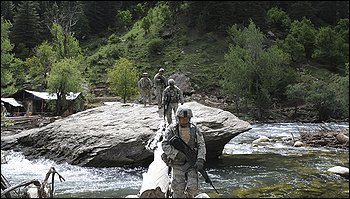
Brostrom, who grew up on Army bases throughout the United States, was charming, athletic and a little bit immature. He arrived in Afghanistan in July 2007 and spent a couple of uneventful months in a battalion staff job before taking over a platoon that occupied a small outpost in Nurestan's Waygal Valley.
The outpost's location, near the tiny village of Bella, was chosen in 2006 because it sat on a historic mujaheddin infiltration route from Pakistan. The idea was to stop enemy fighters in the remote mountains before they made their way to more populated areas.
This account of Brostrom's time in Afghanistan and his final battle is based on interviews with his troops and commanders, as well as the Army's 800-page initial investigation. It also draws from the work of an Army historian whose draft study of the fight was reported by ForeignPolicy.com and The Washington Post in July.
Brostrom entered the war at a time when the Taliban was gaining strength. Shortly after he became platoon leader, his unit was sent to recover the bodies of six U.S. soldiers and a Marine who were gunned down while returning on foot to Bella. One soldier had fallen more than 500 yards down a steep ravine, and it had taken Brostrom's troops and circling attack helicopters more than 15 hours to find him.
After the attack, the other soldiers rarely ventured far from their base. "We felt like we'd been backed into a corner," said Staff Sgt. Jonathan Benton, one of the soldiers from the platoon. "Nothing ever felt safe out there."
In January 2008, Brostrom's platoon sergeant, Sgt. 1st Class Matthew Kahler, was fatally shot by an Afghan security guard as he returned to the outpost from a foot patrol. One of Kahler's jobs had been to teach Brostrom, who was technically his superior, how to lead troops in combat. On a cloudless day at the Bella outpost, Brostrom delivered a simple eulogy for his 29-year-old friend and mentor.
He talked about Kahler's love for his wife and 4-year-old daughter, his patience with young soldiers, and his passion for punk music. "I can't even begin to list all the good qualities Sergeant Kahler had, because it would be impossible," he said, squinting into the bright midday sun and fighting back tears. "I think Sergeant Kahler knew everything."
'A Bloodbath'
Brostrom's battalion commander, Lt. Col. William Ostlund, had concluded months before Kahler's death that keeping troops at the Bella outpost no longer made sense. Enemy fighters coming from Pakistan had long ago learned to maneuver around the base.

But Ostlund wasn't ready to give up the surrounding Waygal Valley, which was home to a largely illiterate and deeply religious population. The isolated valley offered an ideal haven for al-Qaeda and the Taliban. "It was a population I really had a hard time understanding and did not respect," Ostlund said. "But I really did believe that they needed to be connected to the central government and that would be the first step to making them better people, less of a threat to themselves and Afghanistan."
Ostlund, square-jawed and intense, had a reputation in the Army as a high flier. He enlisted at age 17 and earned his bachelor's degree from the University of Nebraska in only four semesters. In the 1990s, he served as a platoon leader for then-Lt. Col. David H. Petraeus, who had risen to become the top commander in the Middle East. "Bill was one of those rare individuals who could truly inspire others," Petraeus recalled. "Whatever the task, his platoon stood out . . . and the tougher the task, the more they stood out." Ostlund went on to earn a master's degree in international relations from Tufts University and to teach at West Point.
He decided to relocate Brostrom's platoon from Bella to a new base at Wanat, which was home to the valley's district governor and police chief. The troops would establish a security bubble around the village and then win the support of local officials with $1.4 million in reconstruction projects.
Ostlund had lost eight soldiers in the Waygal Valley and had twice been ambushed there himself. But he thought that U.S. troops could win the allegiance of the people there. "Americans are hard to dislike for an extended period of time," he said. "I really believe that."