| Page 4 of 4 < Back |
'Almost a Lost Cause'
Interactive Graphic
The Battle of WanatThis audio and video timeline chronicles the battle from the perspective of a lieutenant killed in the fight, Jonathan Brostrom, and his father, who has sought answers to what went wrong. TOOLBOX
   Resize Resize
  COMMENT
 Discussion Policy
 CLOSE CLOSE
Comments that include profanity or personal attacks or other
inappropriate comments or material will be removed from the site.
Additionally, entries that are unsigned or contain "signatures" by
someone other than the actual author will be removed. Finally, we will
take steps to block users who violate any of our posting standards,
terms of use or privacy policies or any other policies governing this
site. Please review the full rules governing commentaries and discussions. You are fully responsible for the content that you post.
Who's Blogging  |
 Why Do I Have to Log In Again?
 Discussion Policy
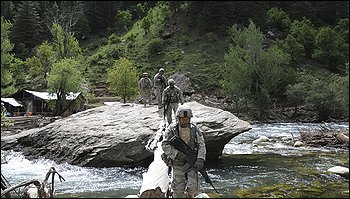
Nothing about the Wanat mission went as planned. Brostrom and his soldiers were supposed to have 16,000 pounds of construction material to build defensive bunkers, big earthmovers to fill seven-foot-tall Hesco barriers, and a five-day supply of water, a senior military official said.
But the Afghan construction firm that was supposed to ferry the construction supplies and build the base refused to make the four-mile drive into the valley because it was too dangerous. A small Bobcat earthmover was delivered to the base by helicopter, but it ran out of gas after one day. Brostrom's soldiers, working in 100-degree heat, chipped away at the rocky soil with shovels to fill sandbags and dirt barriers.
The five-day supply of water also never made it to Wanat, and by their second day at the base, most of the troops were "mildly dehydrated," one soldier told Army investigators.
Two days into the mission, a Predator surveillance drone -- one of only two in Afghanistan -- was shifted from Wanat. No attacks had occurred there during the opening days of the mission, and U.S. commanders decided there were more pressing priorities.
"There should have been a lot more done to help us," said Sgt. 1st Class David Dzwik, who replaced Kahler as Brostrom's platoon sergeant. "The real problem was arrogance. Everyone thought they knew the enemy."
'This Was Going to Be It'
A few days after the platoon arrived, a Wanat village elder gave Brostrom a list of Afghans who had been killed in a helicopter attack the previous week. The dead included insurgents but also several local medical personnel who had worked closely with U.S. soldiers. The incident had infuriated people throughout the valley.
On July 13, their fifth day at the Wanat base, Brostrom and Dzwik ordered all of the soldiers to rise at 3:30 a.m. and man their fighting positions. In Afghanistan, the hours just before dawn are typically the most deadly.
Shortly after 4 a.m., an estimated 200 insurgents let loose a torrent of rocket-propelled-grenade fire, destroying the base's anti-tank missile system and its mortar tubes. Then they trained their guns on the observation post.
The initial blast threw Spec. Tyler Stafford onto his back. He screamed that he was on fire. Next to him, Spec. Matthew Phillips was rearing back to throw a grenade when a rocket came roaring at them. The tailfin ricocheted off Stafford's helmet, leaving a jagged dent. When he looked up, Phillips was dead.

A few feet away, Spec. Christopher McKaig and Spec. Jonathan Ayers prodded each other to raise their heads above the observation post's sandbagged wall. "I am going to count to three and then we are both going to jump up and shoot at whatever we see," McKaig recalled screaming.
The two soldiers leapt to their feet, fired a short burst from their rifles and collapsed. When it came time to rise again, Ayers hesitated. So McKaig started counting. On three, the men rose and a bullet struck Ayers. He coughed up enough blood to fill a teaspoon and fell over dead.
A few minutes later, Brostrom and Hovater sprinted up to the observation post. They were killed within minutes of their arrival.
With the enemy closing in, Stafford, McKaig and Sgt. Matthew Gobble -- woozy from a loss of blood -- abandoned the observation post. In the chaos, they accidentally left behind Sgt. Ryan Pitts, who could hear the enemy fighters barking orders just a few feet away. He whispered into a radio that he was alone and out of ammunition.
"I knew this was going to be it," he later told an Army historian. Soldiers at the main base called to him over the radio, but Pitts didn't answer. The wounded sergeant couldn't afford to let the enemy hear him.
Another team of reinforcements sprinted to the observation post, pulled rifles and ammunition off their dead comrades, and fired back at the insurgents. An hour into the battle, Apache helicopters arrived and swung the momentum in favor of U.S. troops.
Brostrom's friend, Brandon Kennedy, arrived at Wanat a short time later to find soldiers coated in sweat and blood. Thick clouds of smoke spewed from burning Humvees. "I had been in firefights before, but this was totally different," he said. "It was like a movie."
It fell to Kennedy to escort Brostrom's body back to the United States. He asked a sergeant who had done it before what to expect.
"It is always the same," the soldier replied. "The moms just want to know about their son. They want to know what kind of man he was. The dads want to know how their son died. They want someone to explain to them what happened."
This series was researched partly in collaboration with CBS News, whose report on the battle of Wanat and its aftermath will air Monday on the CBS Evening News.