By Shawn Langlois & William Spain, MarketWatch
SAN FRANCISCO (MarketWatch) -- General Motors said Tuesday its new Chevy Volt will get 230 miles per gallon in the city, dwarfing the current mileage leader and giving the automaker reason to crow about its strides in fuel efficiency.
GM, fresh out of bankruptcy, is looking to the Volt to highlight a parade of 25 new vehicles by 2011 aimed at stemming market-share declines and bringing the automaker back to profitability. The Volt could also give GM a much-needed makeover in terms of its reputation for lagging behind the push toward "green" technology.
Scheduled for late 2010, the Volt will be able to travel up to 40 miles on electricity from a single charge, based on testing of pre-production prototypes and extend its overall range to 300 miles or more using a flex fuel-powered engine-generator.
The small engine is only used to power the battery.
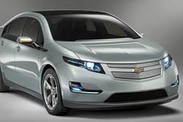 Chevrolet
Actual gas-free mileage will vary depending on the length of travel, the number of passengers, cargo weight and other factors, the company said. The 230 miles per gallon figure is based on tests that used new federal fuel economy standards for plug-in cars.
Fritz Henderson, chief executive of the bailed-out car company, said the Volt is expected to be a "game-changer" for the industry.
"From the data we've seen, many Chevy Volt drivers may be able to be in pure electric mode on a daily basis without having to use any gas," he said in the announcement, citing data from the Department of Transportation data that almost 80% of Americans commute fewer than 40 miles a day.
Using methodology from the Environmental Protection Agency, GM said it expects the Volt to use as little as 25 kilowatt hours per 100 miles in city driving which means that it will cost less than 3 cents per mile to operate.
The competition to push electric technology is heating up, as Ford, Chrysler, Daimler and Toyota are all developing plug-in vehicles. For now, the Volt is taking aim at Toyota's Prius, which achieves 51 mpg with a $22,000 starting price tag.
The Volt is expected to retail for about $40,000.
Shawn Langlois is a reporter for MarketWatch in San Francisco. William Spain is a MarketWatch staff writer in Chicago.









marioc30 1 hour ago
hungry4food 1 hour ago
Demaris 1 hour ago
To boot, I'm National Grid.
CardiacKid 1 hour ago
sweettweet 54 minutes ago
SteenkingBadger87 42 minutes ago
Bilo 31 minutes ago
I heard that the planet Earth is really flat......got any inside info on that one?
Simpleinstrument 43 minutes ago
disgruntledvoter 59 minutes ago
zeejay 53 minutes ago
http://www.nissanusa.com/leaf-electric-car/?=tqd.ev.MCR.aug09evrevealem.HNR
ken2 38 minutes ago
crosscreek 35 minutes ago
tremors1 19 minutes ago
Thank you master, you are so kind and generous.
mixingbowl1 13 minutes ago
BlackMonday 5 minutes ago
actually, it's the distant past.
http://en.wikipedia.org/wiki/Detroit_Electric
pedalpower 33 minutes ago
First elements in the periodic table and their isotopes:
H, Hydrogen-------1 proton, 0 neutrons
H^2, Deuterium---1 proton, 1 neutrons (hydrogen isotope)
H^3, Tritium--------1 proton, 2 neutrons (hydrogen isotope)
He, Helium----------2 protons, 2 neutrons
Li, Lithium----------3 protons, 3 neutrons
.
.
Li^6, Lithium6-------3 protons, 6 neutrons (lithium isotope)
You use an Isotope of lithium (Li^6) and Hydrogen(H^2, Deuterium (from sea water, also known as heavy water)) in a compound known as Lithium-Deuteride and the Lithium isotope (Li^6) breaks down when the plutonium "trigger" goes critical giving Helium (He), Tritium (H^3), Deuterium (H^2) and Hydrogen (H) in various proportions (plus all those extra neutrons). Tritium, which is a common daughter product of nuclear reactions in power reactors is used in watches, night sights for firearms etc., is also the booster in a common garden variety "boosted" nuclear explosive by providing lots of extra neutrons to increase the "alpha" or number of reactions that take place before the explosive components move far enough apart to stop reacting, thus increasing the "yield" or efficiency of the reaction and reducing the amount of "active" components such as Uranium(U^235) or Plutonium (Pu^239).
Tritium (H^3), when combined with hydrogen (H) gives Helium (He) and is the lowest energy method of producing a thermo-nuclear reaction. That being said however, Deuterium (an isotope of hydrogen, H^2) will combine with more Deuterium and also produces Helium (He). Because of this neat little nuclear magic show using Li^6, you don't need liquid fuels at cryogenic temperatures to get into the thermonuclear club. Keeping the fuels dry allowed the development of weapons that could be delivered and stored for reasonable periods of time without cryogenic refrigeration plants.
Sorry about the superscripts, the editor doesn't have any other means to annotate them.
In my next life, I'm going to study finance so I can produce financial derivatives and crash the Stock Market. I just love it when folks like 60 Minutes say that you have to be a "Rocket Scientist" to understand something like "Derivatives". I guess in journalism school they just teach you how to be an empty suit with a pretty face and a good speaking voice. Don't ask about ANFO, that's a secret (just kidding).
Does that help a bit? ;-)
onezero4u 24 minutes ago
maybe Al Gore and global warming scare crew can afford one ha.
Next stop for Barry will be to nationalize energy companies and destroy competetion and charge what ever the govt fancies to charge these ugly government motors shitboxes.
doesnt anyone see, GM sucks and should have went backrupt like every small company that makes overpriced unwanted junk. i hope not 1 dollar of cash for clunker scam goes to GM
picoroble 20 minutes ago
Entasis 20 minutes ago
JackRS 19 minutes ago
My Subaru Forester is getting 26 MPH. So if I bought one of these I'd have to drive over 147,000 miles to break even on gas savings, not counting of course my electric bill and possible battery replacement.
This thing might make sense as a company car for someone who puts 25K or more miles a year traveling around, but it makes no sense for an individual to own. But these kinds of cars don't have the range to be practical as a long range company car. Back to the drawing board Detroit...............
Cougardan 8 minutes ago
capitan 15 minutes ago
You can buy 2 toyota for one Volt. Make your choice ?
WhiteGrace 9 minutes ago
SteenkingBadger87 1 minute ago