(Page 2 of 2)
Several said that on Thursday morning the Qaddafi forces had blasted
peaceful protesters gathered in the square with machine guns and
artillery, pointing to holes in the sides of pillars and even a mosque.
They showed journalists seven fresh graves dug in the square to bury
those killed in the fight, and said at least two others were buried
with their families.
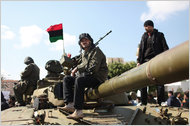
But the battle had made them even more confident of their power, they
said, because military units had joined their cause instead fighting
against them. Some said that in the fights against Italian occupation
and other battles in Libya’s pre-Qaddafi history, their city had earned
the nickname “the silent lion,” and was living up to it again. “When
Qaddafi killed people, Zawiyah became like a volcano,” said Tariq
Mohamed, a resident.
They said the city was now under the control of a committee of
prominent citizens—doctors, lawyers, judges, engineers and the like —
who were organizing its public services and continued defense. “We are
really suffering for 42 years, and people are asking here for the same
things as other people of the world — they want the real democracy,”
said Ahmed el-Hadi Remeh, an engineer standing in the square.
In Benghazi, the eastern city where the revolt began, rebels said that Libyan soldiers had joined the rebels in securing vital oil industry
facilities around that part of the country. And some oil industry
workers fleeing across the Tunisian border in recent days said they had
seen Libyan soldiers fire their weapons to drive off foreign
mercenaries or other security forces who had approached oil facilities.
Hassan Bulifa, who sits who sits on the management committee of the
Arabian Gulf Oil Company, the country’s largest oil producer, said the
rebels control at least 80 percent of the country’s oil assets, and
that his company, based in Benghazi, was cooperating with the rebels.
The company resumed oil shipments on Sunday, loading two tankers at a
port in Tobruk, Mr. Bulifa said. The two ships — one bound for Austria
and the other for China — can carry 1.7 million barrels of oil, and
will represent the company’s first shipments since Feb. 10.
Although the revenue from those sales go the company’s umbrella
organization, Libya’s National Oil Company, Mr. Bulifa said Arabian
Gulf Oil Company had ceased any coordination with the national company,
though it was honoring oil contracts. And he insisted the proceeds
would ultimately flow to the rebels, not Colonel Qaddafi. “Qaddafi and
his gangers will not have a hand on them. We are not worried about the
revenues,” he said.
Despite Mrs. Clinton’s offer of aid, the rebels still seemed far way
from the kind of unity that might allow them to start serious talks
with foreign governments or international agencies. Mrs. Clinton
herself said any talk of recognizing a provisional government was
premature.
On Saturday, the country’s former justice minister, Mustafa Mohamed Abd al-Jalil, said in an interview on Al Jazeera
that he would head a transitional government, with the aim of holding
elections within three months. But on Sunday, another figure in the
rebel movement, Abdel-Hafidh Ghoga, seemed to dismiss that claim,
saying a national council had been formed to manage the “day to day
living” of the “liberated” territories.
The Qaddafi government implicitly acknowledged for the first time on
Sunday that it feared elements of its military falling into rebel
hands, as Colonel Qaddafi’s son Saif said in the television interview
that the Libyan government had bombed its own ammunitions depots in the
east.
And the rebels took further steps to organize a central military
command to counter Colonel Qaddafi’s paramilitary force. In recent
days, several senior officers have joined the rebel side, including
Maj. Gen. Suleiman Mahmoud, who commanded the armed forces in eastern
Libya.
David D. Kirkpatrick reported from Zawiyah, and Kareem Fahim from Benghazi, Libya