
Dozens killed in battle for key Libyan town
Updated

Dozens of people are reported to have died in a second day of fierce fighting for Zawiya. (Reuters: Ahmed Jadallah)
Opposition forces in Libya were surging forward in the east, capturing new towns from the pro-Gaddafi Libyan army, but it was a different story on the other side of the country.
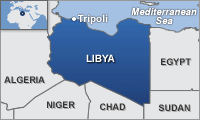
The town of Zawiya, 50 kilometres west of Tripoli, has reportedly fallen to government troops after almost a week of holding out against attempts by the regime to recapture it from the rebels.
Government tanks are reportedly in the town square, and dozens of people are reported to have died in a second day of fierce fighting for control of the coastal town.
Government forces retreated to the outskirts early in the day but later mounted a counter-offensive. Rebels said both attacks were repelled.
The city bore the signs of heavy fighting, with one building completely burnt and smouldering rubble littering the centre.
Other buildings around the main square were riddled with holes from large-calibre weapons.
The atmosphere was tense and the situation appeared fluid as rebels braced for more attacks.
"After the morning attack they attacked again. They entered from the west and started shooting rockets at buildings in the square," rebel spokesman Youssef Shagan said.
"We are in a good position ... They will attack again at night, we think."
A doctor in Zawiya said at least 30 people, mostly civilians, had been killed during fighting in the day, bringing to at least 60 the death toll from two days of battles.
The red, green and black flag of the rebellion flew from many buildings in the square, where rebels shouted anti-Gaddafi slogans atop tanks and armoured personnel carriers captured from the army.
Dozens of rebels armed with rifles manned rooftops, watching nearby streets from behind piles of sandbags. Roads and sidestreets were barricaded with rebel checkpoint.
"The fighting has intensified and the tanks are shelling everything on their way. They have shelled houses," resident Abu Akeel said by telephone.
"Now they are shelling a mosque where hundreds of people are hiding. We can't rescue anyone because the shelling is so heavy."
A doctor in Zawiyah accused fighters loyal to Mr Gaddafi of committing a "massacre" in the town.
"This was a real massacre. The situation is catastrophic. They killed many people. They killed my daughter," the doctor, who was speaking on condition of anonymity, said.
Residents said it was difficult to say how many people were killed in two days of fighting. A government spokesman could not be reached for a comment.
Outside the city, cars loaded with suitcases and boxes piled on their roofs could be seen driving westward towards Libya's border with Tunisia as refugees continued to flee the violence.
The UN says more than 191,000 people have fled the violence in Libya. It says mainly immigrant workers have left, and the bulk of them have gone to Tunisia and Egypt.
Eastern push
In Libya's east, opposition forces are surging forward along the main coastal road, capturing the major oil port of Ras Lanuf and pushing even further forward towards Mr Gaddafi's home city of Sirte.
Morale on that side of the country is sky high and opposition forces are already talking of pushing on to the capital.
Meanwhile, the self-declared National Libyan Council has named a three-member crisis committee, aimed at toppling Mr Gaddafi.
Omar Hariri, one of the officers who took part in the Libyan leader's 1969 coup, has been appointed head of military affairs.
Ali Essawi, a former ambassador to India who quit last month, has been put in charge of foreign affairs, while Mahmoud Jebril has been named head of the crisis committee.
- ABC/Reuters
First posted
Search ABC News
Libya protests
 Crisis in Libya
 Blasts rock Libyan military base
 Obama calls for Gaddafi to leave
 Libyan rebels hold Brega