





Excerpt: "I thought the Yankees would have hung you long before this, for harboring Rebs they found at your house. I suppose they never heard about your going to Colonel Martin's to kill the Union soldier that was left by his company in their stable. Although you shot at me twice before I left you, I did not want to hear of your being hurt, and am glad you are still living."
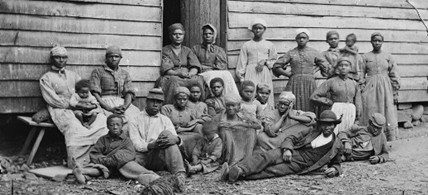
A group of escaped slaves in Virginia in 1862. (photo: The Library of Congress)

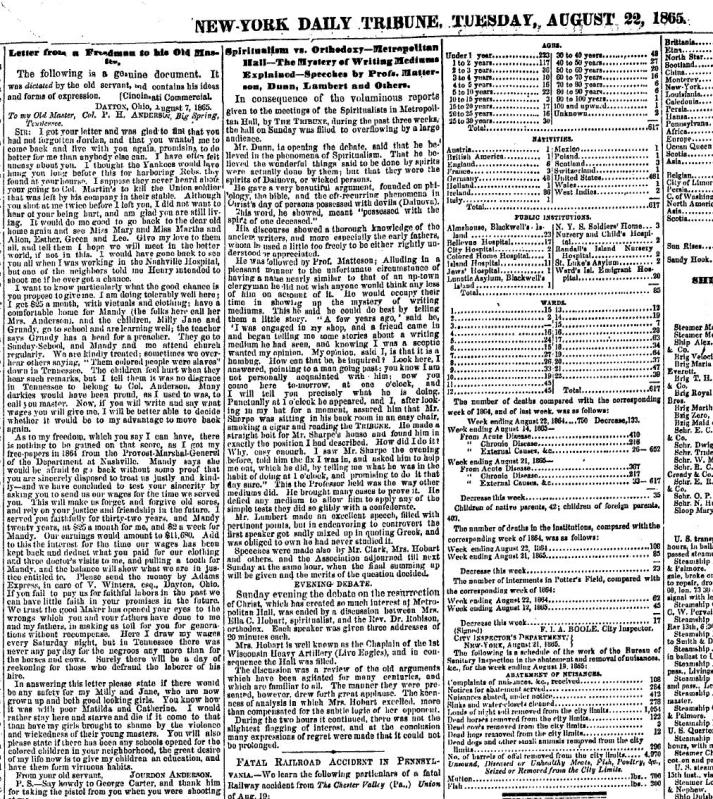
A Letter From a Former Slave
01 February 12
 n
August of 1865, a Colonel P.H. Anderson of Big Spring, Tennessee,
wrote to his former slave, Jourdan Anderson, and requested that he
come back to work on his farm. Jourdan - who, since being emancipated,
had moved to Ohio, found paid work, and was now supporting his family -
responded spectacularly by way of the letter seen below (a letter
which, according to newspapers at the time, he dictated).
n
August of 1865, a Colonel P.H. Anderson of Big Spring, Tennessee,
wrote to his former slave, Jourdan Anderson, and requested that he
come back to work on his farm. Jourdan - who, since being emancipated,
had moved to Ohio, found paid work, and was now supporting his family -
responded spectacularly by way of the letter seen below (a letter
which, according to newspapers at the time, he dictated).
Rather than quote the numerous highlights in this letter, I'll simply leave you to enjoy it. Do make sure you read to the end.
Dayton, Ohio,
August 7, 1865
To My Old Master, Colonel P.H. Anderson, Big Spring, TennesseeSir: I got your letter, and was glad to find that you had not forgotten Jourdon, and that you wanted me to come back and live with you again, promising to do better for me than anybody else can. I have often felt uneasy about you. I thought the Yankees would have hung you long before this, for harboring Rebs they found at your house. I suppose they never heard about your going to Colonel Martin's to kill the Union soldier that was left by his company in their stable. Although you shot at me twice before I left you, I did not want to hear of your being hurt, and am glad you are still living. It would do me good to go back to the dear old home again, and see Miss Mary and Miss Martha and Allen, Esther, Green, and Lee. Give my love to them all, and tell them I hope we will meet in the better world, if not in this. I would have gone back to see you all when I was working in the Nashville Hospital, but one of the neighbors told me that Henry intended to shoot me if he ever got a chance.
I want to know particularly what the good chance is you propose to give me. I am doing tolerably well here. I get twenty-five dollars a month, with victuals and clothing; have a comfortable home for Mandy, - the folks call her Mrs. Anderson, - and the children - Milly, Jane, and Grundy - go to school and are learning well. The teacher says Grundy has a head for a preacher. They go to Sunday school, and Mandy and me attend church regularly. We are kindly treated. Sometimes we overhear others saying, "Them colored people were slaves" down in Tennessee. The children feel hurt when they hear such remarks; but I tell them it was no disgrace in Tennessee to belong to Colonel Anderson. Many darkeys would have been proud, as I used to be, to call you master. Now if you will write and say what wages you will give me, I will be better able to decide whether it would be to my advantage to move back again.
As to my freedom, which you say I can have, there is nothing to be gained on that score, as I got my free papers in 1864 from the Provost-Marshal-General of the Department of Nashville. Mandy says she would be afraid to go back without some proof that you were disposed to treat us justly and kindly; and we have concluded to test your sincerity by asking you to send us our wages for the time we served you. This will make us forget and forgive old scores, and rely on your justice and friendship in the future. I served you faithfully for thirty-two years, and Mandy twenty years. At twenty-five dollars a month for me, and two dollars a week for Mandy, our earnings would amount to eleven thousand six hundred and eighty dollars. Add to this the interest for the time our wages have been kept back, and deduct what you paid for our clothing, and three doctor's visits to me, and pulling a tooth for Mandy, and the balance will show what we are in justice entitled to. Please send the money by Adams's Express, in care of V. Winters, Esq., Dayton, Ohio. If you fail to pay us for faithful labors in the past, we can have little faith in your promises in the future. We trust the good Maker has opened your eyes to the wrongs which you and your fathers have done to me and my fathers, in making us toil for you for generations without recompense. Here I draw my wages every Saturday night; but in Tennessee there was never any pay-day for the negroes any more than for the horses and cows. Surely there will be a day of reckoning for those who defraud the laborer of his hire.
In answering this letter, please state if there would be any safety for my Milly and Jane, who are now grown up, and both good-looking girls. You know how it was with poor Matilda and Catherine. I would rather stay here and starve - and die, if it come to that - than have my girls brought to shame by the violence and wickedness of their young masters. You will also please state if there has been any schools opened for the colored children in your neighborhood. The great desire of my life now is to give my children an education, and have them form virtuous habits.
Say howdy to George Carter, and thank him for taking the pistol from you when you were shooting at me.
From your old servant,
Jourdon Anderson.
|
THE NEW STREAMLINED RSN LOGIN PROCESS: Register once, then login and you are ready to comment. All you need is a Username and a Password of your choosing and you are free to comment whenever you like! Welcome to the Reader Supported News community. |






Live Occupy Wall Street Tweets


 30 January 2012
|
 31 January 2012
|
 01 February 2012
|
 01 February 2012
|
 30 January 2012
|
 31 January 2012
|
 30 January 2012
|
 30 January 2012
|
 31 January 2012
|


Comments
The shackles are different though.Enforced by "contracts" and sheriffs, judges, corporations etc.
UTTERLY flabbergasted at the calm rape and shooting that was tolerated, MORE THAN tolerated, and
the sheer bravery to demand WELL-earned wages. The delicate thinking-one's-way-through-fear - to craft a whole new way of living every day after decades of slaveslaveslavi ng!!!!!!!!!!!
"The likelihood that a smartphone was not touched by a slave is pretty low." http://www.thedailybeast.com/articles/2011/06/28/world-s-hidden-slave-trade-includes-forced-labor-in-u-s-military-contracting.html
He has no intention of going back without getting the pay he and his wife is owed.
He is making a good life for his wife and family and knows his own worth.
I like his parting salvo: Say Howdy to Carter, and thank him for taking the pistol from you, when you were shootin at me.
He is very politely telling the colonel, that he doesn't trust him at all. Great.
I doubt his circumstances in Ohio were as good as he claimed to his former owner. Twenty bucks a month was a damn good wage for anyone in 1865, and racism and Jim Crow were certainly not just a southern phenomenon. But maybe it was true. The man was certainly smart enough.
I love this letter, as it says it all. I can feel with every word the seething disdain for what the slave had experienced.
In fact, some slaves learned to read, despite the legal prohibition about doing so, and could write and many with some elegance. (A friend of mine says her great-great grandmother was a house slave and learned to read, which helps account for the high degree of education in subsequent generations of her family.)
As for the slaveowner's "audacity, this reminds me of a theme in Jacobs' book where her former master did try to get Harriet back by all kinds of means.
Try reading some of the slave narratives and the treatment--rape and way beyond--that slaves endured, or did not endure and died. Try reading "Beloved" by Toni Morrison, an incredible book in all ways.
PBS starts airing a special, "Slavery by another name," and other programs on black slavery and subsequent means of subjugation in our country.
Pay attention. This issue with blacks is far from over.
If you'd look up the Jacob's book you'd find it heavily documented and footnotes, with information from censuses, newspaper accounts, and other available documents.
Interesting how much skepticism there is about literate and intelligent slaves.
Nothing written here approaches the horrendous conditions that existed. Have you ever seen photographs of a slave's back that has been repeatedly whipped with a horsewhip? Those scars are deep and never go away. Neither do the invisible scars, and worse, they get passed down from one generation to another. Which is an underlying reason for some of our racial problems today. Slavery is only a few generations from ours.
Can you imagine at least one person out of that 5 million to be articulate? Don't you think you'd be rather sarcastic if you had spent 32 years as an unpaid laborer and your former "employer," who had tried to shoot you, was asking you to return to your old job without an offer of any kind of salary and benefit package?
And where did you study history, that teaches that the idea of being paid for one's work had not yet come into vogue in the mid 19th century?
He wrote several autobiographies , eloquently describing his experiences in slavery in his 1845 autobiography, "Narrative of the Life of Frederick Douglass, an American Slave."
You have a underdeveloped education of slavery, US history, and life in the 19th century. I suggest you get a library card.
Why now after all these years are people still fighting for rights that should be guaranteed by the constitution? What's wrong with us? I think I know the an$wer!
Even when the topic is specifically and directly about the slavery of black people in the US, ways are always found to deflect, digress, or otherwise steer the discussion somewhere else.
Before we get into the invisible pretend kind of slavery, can we first finish talking about the real visible one that has wreaked havoc in 99% of black Americans' lives for the past few centuries? Can we put a little focus on the concentration camps that hold more than one million young black men who aren't even guilty of protest, loudly or otherwise?
There are plenty of places and opportunities to talk about "the 1%," FEMA, and war with Iran. Let's not go out of our way to avoid the subject at hand.
You seem to be saying that those Africans - who were dragged onto slave ships, torn from their loved ones, kicking and screaming, to endure the horrors of the 'middle passage' holocaust, placed naked upon auction blocks to be prodded like farm animals, bought and sold, forced to work under the threat of whip and gun, have every aspect of their lives tightly regulated and controlled by people who disdain, hate, and think them inferior, whipped bloody and/or raped at whim, forced to helplessly watch their wives, daughters, mothers and other loved ones whipped bloody and/or raped or be sold away from them - were actually lucky and that millions of people that you know of in Central America and sub-Saharan Africa would sell their children to have the good fortune to attain such a high standard of living.
Is that what you're saying?
Besides enlightening us - unsolicited - just how damn happy the world's poor can be with so little, what the hell does any of this have to do with Mr. Anderson of Ohio's letter to Colonel Anderson of Tennessee?
You need to read more mate. A lot of the slave, at great risk to themselves, dared to teach themselves to read and write and some "owners" (that word remains today) actually encouraged this as a they left their own kids in the care of the black women. My own wife's Grandmother in Florida -while not exactly a "slave-owner" had a black cook and housekeeper, treated her very well and left her quite well-off in her will (this was the 1930', 40's and 50,s). Also, Mr. Anderson had been in Ohio for a while and placed great importance on education of himself and his family.
For an in-depth look at this in different times and demographics, read "The Warmth of Other Suns" by Isabell Wilkerson and more currently, the best seller "The Help" by Kathryn Stockett plus "Call Him George" (Lewis) by the great New Orleans clarinetist's manager Jay Allison Stewart.
Hell, I've lived and worked around the South and the attitudes of many whites hasn't changed to this day -and it's not entirely confined to the Bible-Belt either!
http://my.auburnjournal.com/detail/198971.html
or is that issue just too hot to handle?
Women, God be with you, and get to safety.
Language does continuously evolve over time, which is why modern American English is not identical to 13th century English. But the idea of purposely dumbing it down is not a good one. We already are experiencing an excellerated change due to the new abreviated Internet-speak.
I have young people talking to me in letters (omg, lmao, stfu, etc.) and even in shortened code phrases. I don't know what the hell they're talking about.
If that 19th century slave could learn how to read and write well enough to express himself, I think it's fair to expect our children to be motivated to spell correctly, *and* to use the proper case.
RSS feed for comments to this post.