“I have faith that everything will go well,” Chavez told
Venezuelan state television by telephone late Friday. He said he brought
with him a box of books to read to pass the time.
Before
departing for Havana, Chavez addressed allies and soldiers in a speech
filled with references to Jesus Christ and South American independence
hero Simon Bolivar.
“Our (founding) father Simon Bolivar once
said, ‘I am a man of troubles.’ I say as a son of Bolivar, I too am a
man of troubles. We are a people of troubles,” Chavez said. “Let the
troubles come and add like the cross of Christ to the definitive
liberation of the country. With the cross of Christ, one must sometimes
bear pain as a spur to love. It is fuel for love.”
Chavez, who is seeking his fourth term as president, has said the tumor that doctors will try to remove is probably malignant.
“I say this from my gut: With cancer or without cancer ... come rain,
thunder or lightning ... nobody can avoid a great patriotic victory Oct.
7,” the president said. “Long live Chavez!”
Chavez, 57, is
turning to the same Cuban doctors who extracted a baseball-size
cancerous tumor from his pelvic region last summer. This time, the
growth is smaller, about an inch (two centimeters) in diameter.
Cuba
and Venezuela are staunch allies, and Chavez enjoys a warm relationship
with former leader Fidel Castro and his brother Raul.
The
Venezuelan president has not disclosed the precise location of either
tumor, nor said what kind of cancer he had, but described next week’s
surgery as urgent.
Cuban health care is generally considered good,
but oncology experts not involved with Chavez’s care say he could be
taking a risk by skipping more respected facilities in the United
States, Europe or Brazil — which has Latin America’s most advanced
cancer centers with specialized radiation equipment.
“If you have
a ‘common’ cancer, that of the breast, colon or lung ... then it’s
going to be easy to find standards of care that are the same in the
U.S., Brazil or Cuba,” said Dr. Julian Molina, an oncologist at the Mayo
Clinic in Rochester, Minnesota. “The problem comes when you have a
tumor that’s not one of the common ones, and that’s what most of us
suspect Chavez has.”
National Assembly President Diosdado Cabello,
a retired army lieutenant who accompanied Chavez in his failed 1992
coup, said Friday that the Venezuelan opposition should be the most
worried about the president’s survival.
“The people in the street
will not retreat a single millimeter, not a single millimeter, from
what has been accomplished in these 13 years” since Chavez took office,
Cabello said.
Chavez allies have accused their political foes of
hoping the president will die, opening a door for the opposition to win
the Oct. 7 vote.
Rival candidate Henrique Capriles has rejected
such allegations and said he wishes for a Chavez recovery so Capriles
can triumph “fair and square.”
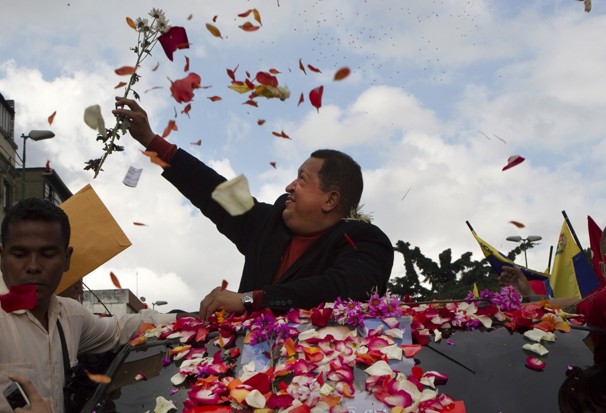
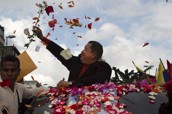
As Chavez’s motorcade traveled
through the streets of Caracas, hundreds of supporters covered his SUV
with flowers and even a portrait of Jesus that read: “I will heal you.
Forward, commander!”
“This goodbye should encourage him. I hope he returns and knows we love him,” said Lucia Cabeza, an unemployed 24-year-old.
For
others, it was just the latest spectacle surrounding a man with a
confirmed flair for the theatric. He was given a similar send-off last
summer when he flew to Cuba for treatment.
“It was a terrible
exaggeration. They took him here, they took him there,” said Fatima
Abreu, a 47-year food vendor. “It’s not the first time he’s leaving, nor
the first time he’s having surgery. Even for his own health, he should
be taking it easy.”
“Chavez has been doing this for 13 years,”
added Margarita de Rodriguez, a 55-year-old homemaker. “Recently they
celebrated the 4th of February, the coup that failed, and now they’re
making a circus of his illness. They always do everything thinking about
the elections.”
Chavez plans to continue governing from Cuba
instead of delegating authority temporarily to Vice President Elias
Jaua. He has not said when he might return to Venezuela.
___
Associated
Press writers Jorge Rueda, Christopher Toothaker and Peter Orsi in
Caracas and Bradley Brooks in Sao Paulo contributed to this report.
Copyright
2012 The Associated Press. All rights reserved. This material may not
be published, broadcast, rewritten or redistributed.


















22
Comments