1907 (1906)(1908)(1908a)(1900-1910)(1910-1920) Table of Contents
Anon. Ocean Park and Venice Timeline (1890-1909), Web Document, 2005b, 1907 See Text
Fred E. Basten Santa Monica Bay: The First 100 Years, A pictorial history of Santa Monica, Venice, Ocean Park, Pacific Palisades, Topanga and Malibu, Douglas-West Publishers: Los Angeles, CA, 1974, 227 pp., 1907, 1906, 1905 See Text
Bath House at Ocean Park, Cal., 1907 See Post Card Images and Text
2701 Bathing Pavilion, Venice of America, California Post Card Venice Postcard Co., 21 Washington St., Venice, CA 90291 GM; Unused. "Venice Plunge was a hot salt water bathing pool on the Ocean Front Walk from 1907 to 1949." See Image and Text
Jorge Caruso SMMR Endorses 3 Council Incumbents, Leaves 1 Open Seat; Tenants Group Also Backs 2 Latinos for School Board, The LookOut News, 7 August 2000, 1907 See Text
Donald M. Cleland A History of the Santa Monica Schools 1876-1951, Santa Monica Unified School District, February 1952 (Copied for the Santa Monica Library, July 22, 1963). 140 pp., 1951, 1922, 1907, 1903 See Text
Home of Paul De Longpre, The Artist in Hollywood, Cal. Post Card, 50098 Newman Post Card Co., Los Angeles, Cal. Made in Germany. KR, 1907 See Images and Text
- Ingersoll's Century History Santa Monica Bay Cities (Being Book Number Two of Ingersoll's Century Series of California Local History Annals) Prefaced with A Brief History of the State of California A Condensed History of Los Angeles County 1542 to 1908 Supplemented with An Encyclopedia of Local Biography and Embellished with Views of Historic Landmarks and Portraits of Representative People. Luther A. Ingersoll Los Angeles 1908, 512 pp., 1908a,1908b, 1907
- Chapter V. Expansion. 1900-1908
- Chapter VII. Public Institutions: Schools; Post Offices; Board of Trade
- Chapter VIII Churches and Societies: Methodist Church; First Presbyterian Church of Santa Monica; Women's Club of Santa Monica; Santa Monica Lodge No. 906, B.P.O.E.; Grand Army of the Republic
- Chapter X. The City of Ocean Park
- Chapter XI Venice of America and Its Founder
- See Text Below, See Photos, 1908b
Paul J. Karlstrom and Susan Ehrlich Turning the Tide: Early Los Angeles Modernists 1920-1956, Barry M. Heisler Introduction Santa Barbara Museum of Art 1990, 1907 See Text
James W. Lunsford The Ocean and the Sunset, The Hills and the Clouds: Looking at Santa Monica, illustrated by Alice N. Lunsford, 1983, 1921, 1920, 1907 2103 Third St. Landmark See Text and Photo
Esther McCoy Irving Gill 1870-1936 Five California Architects, 1960, Reprinted in Marvin Rand Irving J. Gill: Architect 1870-1936, Gibbs Smith, Publisher: Salt Lake City, UT, Design, Ahde Lahti; Photographs, Marvin Rand, 2006, 238 pp. pp. 219-227, 2006a, 1916, 1908, 1907, 1904. 1893, 1890, 1870 See Text
The James D. Schuyler* Papers, SCHU, Water Resources Center Archives, University of California, Berkeley, 1961, 1907 See Text
Windward Ave., Venice, Cal. Post Card Venice Postcard Co., 21 Washington Blvd., Venice, CA 90201. GM; Unused, "Windward Avenue-Venice, Calif. 1907" See Image and Text
Jeffery Stanton Bay Cities Directories, with amendments (In Progress), 2003, 1907 See Text
Jeffrey Stanton Venice of America: 'Coney Island of the Pacific,' Donahue Publishing: Los Angeles, CA, 1987. 176 pp., 1920s, 1911,908, 1907 See Text
Harriet and Fred Rochlin, Pioneer Jews: A New Life in the Far West, Houghton Mifflin Co.: Boston, 1984. 1907, 1900s, 1892, 1877 See Text
Les Storrs Santa Monica Portrait of a City Yesterday and Today, Santa Monica Bank: Santa Monica, CA, 1974, 67 pp., 1907 See Text
Notes:
- 1)[p. 243] Annual Assessment of City of Santa Monica, 1887-1907, 1908a
- 1907 $7,886,310.00
2) In 1907, the property value of the Santa Monica School District totaled $194,000 with an outstanding indebtedness of over $129,000. [25. Annual Report, Santa Monica City Schools, 1906-07, unpublished report in files of Santa Monica Board of Education.] (See Cleland, 1952)
3) The Santa Monica schools are now fully equipped for effective service. Fifty teachers are employed and the attendance for 1907-8 will surpass all previous years. The number of children of school age in May, 1907, was 2,499, 1908a
- 4)"Concrete was a material to which Gill brought a great sympathy, he liked its plasticity, its durability, and its fitness for the "wholly sanitary house." Since the seventies, reinforced concrete had been employed in small buildings on the West Coast, and in 1889 it was used in the Stanford Museum in Palo Alto.
- "Maybeck had tried out reinforced concrete in 1907 in his Lawson house and Maurer studio in Berkeley, and then had returned to wood construction. Gill not only brought architectural conviction to the material but developed a body of detailing which made it accessible for general use." McCoy, 1960
Documents:
-
Anon. Ocean Park and Venice Timeline (1890-1909), Web Document, 2005b, 1907
- "Kinney* and the town's Trustees were embattled in a power struggle over control of Venice of America. When they banned Sunday dancing in his Dance Hall and rescinded his liquor licenses, he closed down operations to deprive the city of most of its tax revenue. The Trustees, who badly miscalculated, yielded.
- "When Kinney* decided to build a new ocean front bathhouse and plunge near his pier, several of the Trustees who owned the Ocean Park Pier refused to issue a building permit. Kinney* didn't wait and poured the concrete foundations. When the sheriff decided to dynamite the foundations in June, the woman's Pick and Shovel Club held a picnic on its walls. The sheriff gave up. Kinney* finished construction and his open-air pool opened in August. It was free to the public.
- "Bowling alleys replace the Japanese Exposition in the pier's Pavilion.
- "Kinney* loses the dis-incorporation election on September 30th. Venice of America remains part of Ocean Park.
- "Venice's new city hall, located on the eastern outskirts of the community opened on October 31st. When the citizens passed a bond issue to finance it, Kinney offered several parcels of land that would have given it a central location. But the Trustees who were at odds with him, instead accepted a ten acre site for $5000 offered by David Evans* who was friends with Mayor Burke*. A building contract for $10,798 was awarded in May. When it opened, citizens dubbed it "Tokio Palace" because they thought it was about as far away as its namesake in the Orient."
- "The Sells-Floto Circus made Venice their winter quarters from December to March. They returned in 1907 and 1910."
-
Fred E. Basten Santa Monica Bay: The First 100 Years, A pictorial history of Santa Monica, Venice, Ocean Park, Pacific Palisades,Topanga and Malibu, Douglas-West Publishers: Los Angeles, CA, 1974, 227 pp., 1907, 1906, 1905
"In October, 1905, a board was elected to draft a charter for the City of Santa Monica. The following year, the charter was ratified at public election and in 1907 approved by the State Legislature. The original townsite had long since overspread its boundaries, particularly in the southeast where it had gone far beyond Pico Boulevard into La Ballona Rancho." p. 87
Bath House at Ocean Park, Cal., 1907
Bath House at Ocean Park, Cal., No. 5173. Publ. by Newman Post Card Co., Los Angeles, Cal. (Made in Germany.) Franked with the green one cent Benjamin Franklin and postmarked Ocean Park, Sep 27 9:30AM CAL. 1907 The Post Card is addressed to Miss Ethyl L. Good, 202 Summit St., Norristown, Pennsylvania; Dated Ocean Park, Sept 26 1907, It reads "My Dearest Daughter, Aunt Mary & I have been to visit this place today so I'll send you a view. I will write a letter to you tonight. Pearl is better. All send love to all Mamie & family. Loving Mama.
Ocean Park Bathing Pavilion, LMU Collection:
http://digitalcollections.lmu.edu/cdm4/item_viewer.php?CISOROOT=/chgface&CISOPTR=223&REC=2
2701 Bathing Pavilion, Venice of America, California Post Card
2701 Bathing Pavilion, Venice of America, California Post Card Venice Postcard Co., 21 Washington St., Venice, CA 90291 GM; Unused. "Venice Plunge was a hot salt water bathing pool on the Ocean Front Walk from 1907 to 1949."
Jorge Caruso SMMR Endorses 3 Council Incumbents, Leaves 1 Open Seat; Tenants Group Also Backs 2 Latinos for School Board, The LookOut News, 7 August 2000, 1907
"Santa Monica voted for a $500 limit on civil fines in 1907."
Donald M. Cleland A History of the Santa Monica Schools 1876-1951, Santa Monica Unified School District, February 1952 (Copied for the Santa Monica Library, July 22, 1963). 140 pp., 1951, 1922, 1915, 1907, 1903
" . . .
It is perhaps worthy of mention that Nettie Rice* has served the Santa Monica City Schools for a longer period of time than has any other teacher in the system. First employed by the Board in 1903, she was assigned to teach second grade in the South Side School. After four years in this position, she was appointed principal of the Garfield School, in which capacity she served from 1907 until 1922. From 1922, when she returned to the classroom until her retirement in 1951, Miss Rice* was a teacher in the Lincoln Junior High School. [56. Pearl, op. cit., p. 34.] Her devotion to her work and her selfless service to both her day and evening classes have won for her the admiration and esteem of the entire community.
" . . .
" . . . on July 5, 1907, a clerk was approved for the superintendent's office, and Beulah Blankenship was employed at the rate of $40.00 a month.
"With the granting of a city charter to Santa Monica in 1906, the schools passed from the jurisdiction of the County Superintendent of Schools to that of the Santa Monica Board of Education. This change afforded the city an opportunity, through its Board of Education, to create its own courses of study and establish its own educational policies, in accord with the general school law of the state."
" . . . "
Special Services
Many special services have been introduced in the Santa Monica schools during the years, some of the earlier ones being these: [46: Martin, op. cit., p. 60.]
1907 Dr. C.A. Jenks authorized as the first School Doctor.
" . . . "
Home of Paul De Longpre, The Artist in Hollywood, Cal. Post Card, 1907
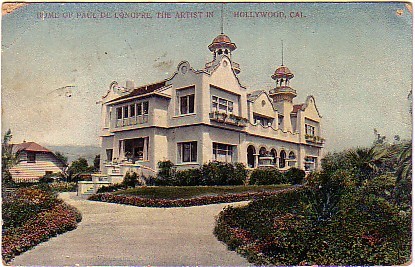
Home of Paul De Longpre, The Artist in Hollywood, Cal. Post Card, 50098 Newman Post Card Co., Los Angeles, Cal. Made in Germany. KR, 1907
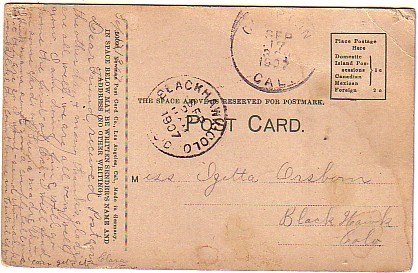
Addressed to Miss Izetta Orsborn, Black Hawk, Colo. and Postmarked Sep. 17, 1907 C . . . ton Cal. and Sep. 20, 1907 Blackhawk, Colo.
In the space below may be written sender's name and address (No other writing.) Sept. 17, 1907 Dear Friend received Postcard the other day & many thanks. Glad you are all well. We are all very well now. I am doing fine & will go home the first of Oct. I will find you some cards of the Sierra Madre and . . . Clara
Ingersoll's Century History Santa Monica Bay Cities (Being Book Number Two of Ingersoll's Century Series of California Local History Annals) Prefaced with A Brief History of the State of California A Condensed History of Los Angeles County 1542 to 1908 Supplemented with An Encyclopedia of Local Biography and Embellished with Views of Historic Landmarks and Portraits of Representative People. Luther A. Ingersoll Los Angeles 1908, 512 pp., 1908, 1908a, 1908b, 1907
[p. 237] Chapter V. Expansion. 1900-1908, 2007
During 1906 the garbage incinerator was completed for Santa Monica and various mains were constructed in preparation for the erection of a septic tank. But a suitable location for the septic tank and outfall system could not be found. The entire community was canvassed; innumerable suggestions were made by the citizens, the council and by outsiders; but no solution of the matter that promised to satisfy all was reached until September, 1907 when the board of trade presented a plan, which was adopted by the council and which promises to be a complete success. This was, in brief, the building of a substantial pier at the foot of Colorado street; the location of a septic tank and pumping plant at the shore end of the wharf and the discharge of the outfall at the extremity, 1700 feet from the shore. This plan met with approval all around and was ratified by the voting of $160,000 bonds for carrying it out September 30th, 1907. Bids have been called for and the work will be pushed on the completion of the system as rapidly as possible.
" . . .
[p. 241] 1907.
The most important advance of the year has been the final action in the matter of sewage disposal. After long agitation a plan which seemed to the majority to be feasible and desirable was suggested and on September 30th bonds to the amount of $150,000 were voted for the building of a 1700-foot pier at the foot of Colorado avenue which will carry the outfall sewer pipe from the septic tank at the foot of Colorado avenue. A number of other improvements will follow the completion of this wharf. During the year building permits to the amount of $250,000 were granted. These included the $10,000 addition to the M.E. Church; a new garbage incinerator, the new postoffice building and many private residences. The Santa Monica Development Company is engaged in the construction of a large reservoir, for impounding additional water for the city supply, in Sepulveda cañon. It will have a capacity of about two million gallons and will cost $75,000. An independent gas company has been organized and promises to become a factor in the situation. The demand for real estate, while not so active as during the previous years, has been steady and property in "old Santa Monica" continues steadily to increase in desirability.
[p. 242 A.F. Johnston, 1908b]
The city of Santa Monica, after passing through many stages of development, is now a clean, well ordered, and most attractive place of residence. At present it has no hotel, no first-class restaurant and offers few attractions to the transient, or the crowd; but it draws a constantly increasing number of perma- [p. 243] nent residents of the better class; while attractive cottages and apartments are filled by the people who wish to pass a restful season at the beach.
". . . . . .
- Photo: Santa Monica School District Board of Education, 1907, p. 264, 1908, 1908a, 1908b, 1907
- H.M. Rebok, Superintendent of Schools; D.G. Holt, President; J.D. Blanchard*; E.V. Dales*; H.J. Engelbreacht; W.R. Snyder; R.M. Miller, Secretary of the Board, 1908, 1908a, 1908b, 1907
" . . .
- [p. 267] Chapter VII Public Institutions
Schools
The Santa Monica schools are now fully equipped for effective service. Fifty teachers are employed and the attendance for 1907-8 will surpass all previous years. The number of children of school age in May, 1907, was 2,499.
" . . .
- [p. 270] 1907 Santa Monica City
Board of Education,
W.E, Devore, A.B. Clapp, E.V. Dales, D.G. Holt, and W.S. Vawter
" . . .
[p. 270] Supervising Principals of Santa Monica Schools:
- 1902-07: D.A. Eckert (superintendent).
- 1907- : Horace Rebok (superintendent).
- ". . .
[p. 283] PostOffices
- . . . in 1907 a building was erected especially to accomodate the [Santa Monica] postoffice and has been equipped with every convenience for the postoffice force and for the public.
- " . . .
[p. 286, 1906-07, 1900s] Board of Trade-Chamber of Commerce-Improvement Club-Board of Trade-Chamber of Commerce-Santa Monica Municipal League-Santa Monica Board of Trade
Much valuable work for the good of Santa Monica was accomplished during the new year of 1906-07. One of the most important moves was the effort made to secure free mail delivery and the promise finally secured that such delivery would be provided for as soon as arrangements could be completed. Attention of the department was also drawn to the inadequate accomodations furnished the Santa Monica postoffice and the result has been the securing of new and ample quarters. Another important step was the action of the board, in recommending that Santa Monica merchants withdraw their business from the L.A.P. road until that company granted a five-cent fare within the city limits. Largely through the action of this body, the fine system of lighting Ocean avenue was adopted. But the most important work of the organization was in connection with the sewer problem. It secured and presented the plan of disposal which has finally been adopted and which it is confidently believed will settle for all time this troublesome subject which has disturbed the peace of mind of the community for many years.
- At the third annual meeting held in October, 1907, Mr. Hull declined to be re-elected, and J.J. Seymour was chosen as president, R. Fogel was elected vice-president, and W.K. Cowan, treasurer.
- " . . .
[p. 288] Chapter VIII Churches and Societies: Methodist Church; First Presbyterian Church of Santa Monica; Santa Monica Lodge No. 906, B.P.O.E.; Grand Army of the Republic
[p.281] [First Methodist Church, 1908b]
- [p. 288] Now, in 1907, the Methodist church has a membership of 240, while the Sunday school reaches 350. So rapid has been the growth of the church and congregation that the church of ten years ago is inadequate and an addition which will more than double the seating capacity of the structure is in course of erection.
- " . . .
[p. 292] First Presbyterian Church of Santa Monica
In the summer of 1907 a fine pipe organ was placed in the church as a memorial gift from Mr. Joseph H. Clark to the memory of his son, Edward H. Clark. It was built by the Estey Company and was installed at a cost of $2,600.
- The following ministers have served the church since 1875 as pastors, or as stated supplies: I.M. Condit, H.V. Noyes, John W. Ellis, H. Mackay, Thos. F. Fotheringham, Williel O. Thompson, J.W. Healy, Richmond Logan, James White, Samuel H. Weller, Enos P. Baker, J.B. Stewart, William R. Henderson, O.F. Wisner, Amos A. Randall, Henry P. Wilber. The following have served as ruling elders: G.H. Clark, J.C. Olmstead, Geo.A. Armstrong, William E. Case, H.H. Dow, George D. Rowan, Andrew J. Viele, John M. Coyner, James E. Ward, C.S. Dales, Clarkson N, Guyer, T.H. Wells, H,J. White, T.E, Cramer
- " . . .
[p. 300] Chapter VIII. Women's Club of Santa Monica
- . . . During 1907 they [the Women's Club of Santa Monica] voted a scholarship fund to be used in keeping a bright girl who otherwise must have given up school, in the high school of Santa Monica. Surely a more practical and beautiful service could not be found. As will be seen this club has done most effective work in benefitting the community, as well as furnishing its members with much intellectual and social pleasure and development.
- " . . .
- [p. 301] At the annual meeting of 1907, Mrs. A.M. Jamison, who had served most efficiently as president for two years, declined a re-election and Miss Charlena Welch was chosen as president.
- " . . .
[p. 301] Chapter VIII. Santa Monica Lodge No. 906, B.P.O.E.
On April 12th, 1907, the Santa Monica Lodge of Elks was organized as Santa Monica Lodge No. 906, B.P.O.E., the Los Angeles Lodge to the number of 300 coming down to initiate the new lodge. After the ceremonies of initiation 400 Elks sat down to a banquet in the old Pavilion, which was one of the most memorable affairs of the many that took place in the old building. The first officers of the lodge were: First Exalted Ruler, Brother W.T. Gillis; Esteemed Leading Knight, Robert F. Jones; Esteemed Loyal Knight, T.H. Dudley; Esteemed Lecturing Knight, G.F. Doty; treasurer, J. Euclid Miles; secretary, J.B. Proctor; Tyler, H.I. Pritchard; trustees, H.G. Englebrecht, C.M. Linder, E.S. Tomblin.
The first lodge rooms of the Elks were located over the Santa Monica bank . . . Soon after the organization of the lodge it acquired the property on the corner of Ocean and Arizona avenues, formerly the home of Mrs. Doria Jones, of Los Angeles, one of the most commodious family residences in Santa Monica. This was altered and refitted as a club house for the use of the members of the Elks Lodge and is one of the pleasantest and cosiest club houses in the country.
" . . .
[p. 303] Chapter VIII. Grand Army of the Republic
[p. 302, Maj. Robert Dollard, 1908b]
On May 20th, 1907, a number of old soldiers met and resolved to form a new post, to be known as the Stephen Jackson Post, No. 191. The post commander of this organization is Robert Dollard; senior vice-commander, A.N. Archer; junior vice-commander, David Johnson; chaplain, T.B. Fisher; quartermaster, S.D. Hayes; officer of the day, J.W. Bowlden; officer of the guard, J.N. Lewis; adjutant, H.C. Towner. Chartered members, George Young, J.L. Ferguson, Thomas Gilroy, W.W.R. Mattox, A.G. Ford, S.A. Wheeler, C.L. Wells, James P. Rutledge, L.M. Pence, M.D. Gage, C.W. Loving, D.W. Collis, J.M. McGlinch, Loyal L. Case, I.J. Lucas, Ed. Forbes, J. Teach, J.O. Hodgson, Peter Mardy (deceased), J.A. Greenslaw, G.W. Heimer, R. P. Elliott, A. Lockridge, E.R. Kennedy, W.W. Woodruff, A. Felix Gandy, George Pulham, James Stone.
Ladies' Grand Army Circle was organized as Fremont Circle, No. 37, Department of California and Nevada, 104. Mrs. Mamie Young, president; Mrs. S.A. Wheeler, vice-president; Mrs. Zoe Phyfer, treasurer.
" . . .
- [p. 317] Chapter X. The City of Ocean Park
The history of the town of Ocean Park with Venice of America, both now less than three years old, is a modern business romance-a romance of fair dreams and marvelous fulfillments; of great ambitions and of saddening failures; of wonderful growth in wealth and population and of bitter contests of strong men with strong men. Many of the events in this brief history partake of the comedy nature; there are elements of tragedy in the story, too-of fortunes made and lost, of high hopes disappointed. There are signs of promise also, a city built upon sand-and yet planted upon a solid foundation of prosperity and steady growth.
- It scarcely seems credible, even to those who have seen the transformation going on before their eyes, that the ground now occupied by beautiful homes and handsome building blocks was, less than six years ago, a barren waste, looked upon as practically useless for building or for any other purpose. The energy, the large conceptions and the large investment which have brought about the changes have rarely been equalled-even in this land of commercial wonders. A rise in values within five years from a few dollars an acre to $15,000 for a twenty -foot lot is not often recorded even in Califonia.
- " . . .
[p. 323, Ocean Park City Hall, 1908b]
[p. 324] The location of the city hall and public buildlings was another topic which led to discord. After the bonds had been voted for this purpose, Abbot Kinney offered a site on Windward avenue. Another site, containing several lots, was offered free of cost on the Venice Gateway tract, at a considerable distance from the business section of the town. The latter site was finally accepted and the trustees put the entire bond issue into the construction of a public building here, although many citizens objected strenuously on account of the inconvenience of the location. Other differences of opinion arose between the city trustees and the Venice interests owned by the Abbot Kinnney Company and finally the breach was so widened that it was proposed to disincoporate the town of Ocean Park and make a fresh start. After a hotly waged contest, in which every resource of each side was taxed to its utmost, a disincorporation election was finally called for September 30th, 1907. At that election the vote stood 202 for disincorporation to 176 against, lacking 60 votes of the requisite two-thirds majority. As a result of this election and the fight preceeding it, many damage suits for libel were filed and promises of future disincorporation were freely made. It was suggested that Venice might ultimately become an annex of Los Angeles. There was talk, too, of a greater Santa Monica, which should be made up of Santa Monica, Ocean Park and Venice united as a happy family in one corporation. But such an iridescent dream was received with smiles by most residents of the beach.
" . . .
[p. 334, 1907] Chapter XI Venice of America and Its Founder
In January, 1907 the Venice Chamber of Commerce was organized with Dr. John Stanwood as president; J.G. French first vice-preesident; David Evans, second vice-president; Lewis Bradt, secretary and R.A. Dullugge, treasurer. The directors were Abbot Kinney, J.D. Simpson, Dr. J.B. Sands, H.C. Mayes, F.E. Reid, R.A. Phillips, Henry Wildey. This organization has since its formation taken an active part in everything pertaining to the welfare of Venice. It has been especially concerned in furthering Mr. Kinney's plans for a deep-sea harbor. The Venice harbor will be the nearest to Los Angeles, the least costly to build, the easiest to enter and to leave, and the safest from storm of any on the Pacific Coast. The plans have been approved by the government and it is expected that they will be carried out in the near future. The Chamber of Commerce took a leading part in the effor for disincorporation; in securing the Polytechnic High School, and in many other ways it has worked for the advancement of the community. At its second annual meeting, the officers chosen were Dr. J.A. Stanwood, president; J.G. French, first vice-president; H.P. Eakins, second vice-president; W.A. Rennie, secretary; R.A. Dullugge, treasurer. The executive committee consists of Abbot Kinney, H. Wickizer, H.C. Mayes, Dr. J.M. White, T.R. Taylor, C.A. Stavenow.
Paul J. Karlstrom and Susan Ehrlich Turning the Tide: Early Los Angeles Modernists 1920-1956, Barry M. Heisler Introduction Santa Barbara Museum of Art 1990, 1907
Stanton Macdonald-Wright (1890-1973), 1990, 1913, 1912, 1910, 1907, 1904, 1900, 1890
"Creator of a modernist style based on pure, spectral color, Stanton Macdonald-Wright served as an early American pioneer of chromantic abstraction. Born in Charlottesville, Virginia on 8 July 1890, he developed an interest in art in his childhood when, after turning five, he took private painting instruction. In 1900 he moved with his family to Santa Monica, California, where he boasted dismissal from several schools. Courting adventure, he sailed the Pacific as a deck hand, stopping for a while on Maui to savor rustic existence.
"Back in Los Angeles in 1904, Macdonald-Wright took courses at the Art Students League in downtown Los Angeles with Warren T. Hedges, a one-time colleague of Ash Can painter Robert Henri. Three years later, still itching with wanderlust and wishing to study abroad, he married and traveled with his bride to France. Settling in Paris, he took courses at the Sorbonne and sampled classes at the Academie Colorossi, the Academie Julien, and the Ecole des Beaux Arts."
James W. Lunsford The Ocean and the Sunset, The Hills and the Clouds: Looking at Santa Monica, illustrated by Alice N. Lunsford, 1983, 1921, 1920, 1907
Ocean Park
"54. The Baron's Castle, 2103 Third Street. A Moorish villa designed and erected in 1907 by Nicolas Baida, a Syrian-born art dealer. With its three stories topped off by a large dome and its elaborately landscaped grounds, it was known as "The Palace" in its early years. In 1920 and 1921 it served as a convalescent home for veterans of World War I. It was eventually acquired by Baron Michel Leone, a professional wrestler who built the new portions of the building and gave it the name Baron's Castle.
Built in 1907 by N. Baida. Photo from USC Digital Archives.
Esther McCoy Irving Gill 1870-1936 Five California Architects, 1960, Reprinted in Marvin Rand Irving J. Gill: Architect 1870-1936, Gibbs Smith, Publisher: Salt Lake City, UT, Design, Ahde Lahti; Photographs, Marvin Rand, 2006, 238 pp. pp. 219-227, 2006a, 1916, 1908, 1907, 1904. 1893, 1890, 1870
"After his success in the East, Gill returned to San Diego to find himself much sought after at home. In 1904 he designed a Christian Science Church, four residences and a theater; he also built a house for himself that year.
"He was still the young eclectic working mainly in brick and half-timbered style. In his own house, and in others he built, in 1905, he began to find his direction. But it was not until after 1906, when his partnership with Hebbard ended, that he was on sure ground.
"In the meantime his interiors had already developed in the direction of elimination and simplification typical of his mature work.
"The redwood was used in dimensions large enough to register the nature of the wood, often 12-inch boards. Moldings were 2 by 3/4-inch stock with sanded edges. Balustrades were made of square or rectangular sticking, a practice Gill continued up through the Dodge house of 1916. The only finish given the redwood was a sanding and hand polishing. He (p. 221) considered it a sacrilege tro use oil, stain, or even wax on redwood. In the Christian Science Church he omitted moldings entirely, although they were added later "to give a finish touch." On the third floor of the Marston House, he tried out doors made of five pieces of redwood, a step in the direction of his slab doors of 1907. He used magnesite in bathrooms and kitchens, and designed and cast in brass the hardware for all his buildings.
"He was impatient with the infinite number of parts in a house; the wood frame seemed to him to be something hooked together, and he set himself to the business of simplifying structure, of eliminating, and making one piece do the work of ten, According to his nephew, "He was always trying to do something better. A window had 24 parts, and he designed one with four; then he found out the cost was the same. He looked for ways to apply plaster in his half-timbered houses to prevent it from shrinking away from the wood. He never stopped. He was never satisfied."
"When he built a minimum house for himself in 1904, he experimented with structure. For some of the interior walls he tried out 1 by 4-inch studs, 4 inches apart, over which he placed diagonal lathing and plaster. The finished walls were 3 inches thick, and they tested equal to the 2 by 4-inch studs 16 inches on center, which made a 5 1/2 inch wall. Plaster filled the openings between the 1 by 4-inch studs, so there was no spaces to act as fire flues.
"Pleased with his experiments, Gill used the system for exterior walls and partitions in a house he designed in 1905 for Miss Alice Lee, the first of three commissions he undertook for her. The house was significant for another reason. The exterior was entirely of stucco, the form more compact, and the roof lower in pitch. Although he continued to design a few houses in half-timbered style, and did two shingled ones in 1906, he was moving toward the adobe forms of the mission builders, who had neither the time nor the tools to be other than frank.
"Between the half-timbered and shingle houses and the ultimate ones in concrete, there were a number between 1906 and 1912 that showed the influence of the Prairie style in their strong horizontal lines and broad sheltering roofs.
"At a time when houses were dim, Gill's were invariably bright. This came from the direct approach of the Chicago school to lighting office buildings. Sullivan's three-division window, with fixed glass in the center and an operating pane on each side, was typical of Gill's design.
"By 1907, after ten years in California, he began to find what he was looking for. His changes in style always followed closely his changes in systems of construction. In the Melvill Klauber and Homer Laughlin houses of that year he used concrete and hollow tile and furred out the interior walls. The tile was an excellent insulating material, and as the concrete did not shrink away from it there was less possibility of cracks.
"The Klauber house had a gable roof with a slight Janpanese curve in the pitch, while the roof of the Laughlin house was low and covered with tiles. Another change came in the interiors of the Laughlin house, where a minimum of wood was used. For about eight years, Gill had coved his kitchen and bathroom walls into concrete floors; in the Laughlin house he carried this treatment throughout the entire house.
"His inventiveness was applied to more than structure. A garbage disposal in the kitchen dropped garbage to an incinerator in the basement; an outlet for a vacuum cleaner in each room carried dust to the furnace in the basement through a pipe in the wall. The ice box in the kitchen could be opened from outside the house so it was unnecessary for the delivery man to enter the kitchen; milk could also be delivered through a slot. In the garage an automatic car washing device sprayed the car's entire surface; and a mail box flush with the front door emptied mail inside the house.
" . . .
"Gill summed up his practices in The Craftsman, May, 1916: "In California we have long been experimenting with the idea of producing a perfectly sanitary, labor-saving house, one where the maximum of comfort may be had with the minimum of drudgery. In the recent houses that I have built , the walls are finished flush with the casings and the line where the wall joins the flooring is slightly rounded. so that it forms one continuous piece with no place for dust to enter or to lodge, or crack for vermin of any kind to exist. There is no molding for pictures, plates or chairs, no baseboard, paneling or wainscoting to catch and hold the dust. The doors are single slabs of hand-polished mahogany swung on invisible hinges or else made so that they slide into the wall. In some of the houses all windows and door frames are of steel."
"His sinks were set in magnesite, which was cast in one piece with the walls, and all the corners rounded, "so not a particle of grease or dirt can lodgte, or dampness collect and become unwholesome. The bath tubs are boxed and covered with magnesite up to the porcelain."
"Superficially Gill might well have been classed as a rationalist, but his approach to work was that of the humanist. His passionate interest in sanitation and light was the basis for much of his simplification. His memory of his mother's inconvenient kitchen led him to devise ways to lighten the tasks in the home.
"Indeed his houses were planned around women. Frederick Gutheim, architectural historian, said, "He spoke often of the practical details of housework, of the obligations of a hostess, of the house as a place for individual creative expression and activities, including gardening." In his low cost house he wanted a tree in every back yard so that a baby's basket could be hung from a limb.
The James D. Schuyler* Papers, SCHU, Water Resources Center Archives, University of California, Berkeley, 1961, 1907
Los Angeles County
- [Box 4]
- [Folder 18.1] Schuyler, J. D.
- Report on stability of Sepulveda Canyon Dam, under construction by the Santa Monica Water Co. 1907. 14 leaves, bound.
- Letter report to J. J. Davis, Esq., Secretary, Santa Monica Water Co., Santa Monica, Calif.
- [Folder 18.2] Hincks, Harvey W.
- Estimates and plans of the dam under construction at Sepulveda Canyon. 1907. 5 leaves, bound : maps.
- Letter report to Santa Monica Land & Water Co., Los Angeles.
- [Folder 18.3] Schuyler, J. D.
- Report on the proposed hydraulic-fill dam in Sullivan Canyon, for the Santa Monica Land & Water Company, accompanying plans and specifications. 1907. 1 v. (ca. 40 leaves), bound : maps.
- Letter report to Santa Monica Land & Water Co., Los Angeles; prepared at the request of J. J. Davis.
Jeffrey Stanton Venice of America: 'Coney Island of the Pacific,' Donahue Publishing: Los Angeles, CA, 1987. 176 pp., 1920s, 1911, 1908, 1907
Chapter 2: Coney Island of the Pacific (1907-1912)
"In the spring of 1907, Venice of America and Ocean Park, two sections of the city with opposing business interests were experiencing a series of muted differences. Neither the Marine Street businessmen led by G.M. Jones in Ocean Park, nor the Kinney people in Venice dared risk an open feud because it would be bad for business. The basic problem was that two rival communities were growing up in one municipality.
"Venice in 1907 was part of the city of Ocean Park which had previously dis-incorporated from the city of Santa Monica several years before. The issue had been over differences in attitudes among Santa Monica citizens dealing with gambling and serving alcoholic beverages in the Ocean Park pier district.
"There was a power struggle going on between Kinney and Ocean Park's five man Board of Trustees, two of whom were his ex-partners. At first their tactics were subtle; they provided less than adequate police, fire protection and garbage collection in the Venice of America area. When the citizens passed a bond issue to finance the City Hall, Kinney offered several land parcels that would have been fairly central to the community. Instead the trustees accepted a 10 acre site offered by David Evans, a partner of Mayor Burke. The land was in Venice's outback, . . . Despite an unofficial straw vote by the property owners in favor of an alternative site, the Trustees paid Evans $5,000 for the property and awarded the building contract to a contractor in May.
"Meanwhile Kinney . . . decided to consolidate . . . his two amusement areas . . . on the beach.
"When he applied for a construction permit for his bath house, the Board of Trustees refused to act. Several of them, who owned the Ocean Park Bath house, a mile north of Windward Avenue, were accused of being afraid of the competition. . . . Kinney . . . ordered his men to pour the concrete foundations for his new bathhouse." p. 36
"The Trustees were infuriated. They immediately pulled the licenses for Kinney's tent city, and ordered it removed. His liquor licenses were revoked, dancing was banned in the pier ballroom, and Marshall G.G. Watt was instructed to remove the foundation of the bathhouse by whatever means possible.
"The bathhouse foundation was scheduled for demolition by dynamite on Monday, June 10, 1907, a day when the beach crowds would be gone. Marshall Watt posted the necessary warning signs. But early that morning women and children began arriving with picnic baskets. At 9:30 a.m. Watt ordered them to disperse-they didn't move. Soon more than 200 women, mostly from the Pick and Shovel Club, a civic club of which Mrs. Kinney was an ardent supporter, were picnicking on the uncompleted walls . . .
"George Culver, city street superintendent, who was to perform the demolition, . . . at noon gave up . . . and the city Trustees did not attempt to demolish it again.
" . . . the incident focused attention on Jones' boss rule and the corrupt Board of Trustees.
"Kinney's strategy was to dis-incorporate . . .
" . . .
" . . . the dis-incorporation election was held on September 30, 1907. . . The election was fought bitterly by both sides." p.31
"Ocean Park forces won a hollow victory. Although Kinney's supporter's were clearly dominant, 206 to 176, they couldn't muster the necessary two thirds majority to dis-incorporate. The city government began to fall apart shortly thereafter, as several Trustees resigned under duress for their involvement in police department corruption. Kinney got his revenge in the 1908 spring elections. His Good Government League candidates forced the remainder of the Ocean Park supported Trustees out of office and controlled the Board of Trustees into the early 1920's.
"It would be another three years, in another election before voters would finally change the name of their city officially to Venice. By 1911, . . . " p.33
[In 1907 a concert by Placido Gilgi's sixteen piece band at Kinney's Midway Plaisance, where all the buildings had been painted white. "The attractions included Leora's trapeze act, and Tarasca's daring bicycle ride in which he rode down a steep ramp to gain enough speed to leap through a circle of fire, then across a 36 foot wide gap.] p. 33
Harriet and Fred Rochlin, Pioneer Jews: A New Life in the Far West, Houghton Mifflin Co.: Boston, 1984, 1907, 1900s, 1892, 1877
" . . . In the early 1900s Gertrude Stein, figuratively, swam far out to sea, caught an incoming wave, rode it to shore, and planted her flag triumphantly in the twentieth century. Of her abundant achievements, none superceded her early understanding and enthusiastic espousal of the baffling new age. She sensed the character of the emerging epoch, said Stein, because she was a westerner and had a pioneer's affinity for the new. Like other westerners who went east (to Paris) to find the timeless West within the mind (as literary critic William Gass put it), Stein was most extravagantly a westerner when far from home.
" . . . Stein described her longtime companion, Alice B. Toklas, the granddaughter of a Jewish Forty-niner, to be "as ardently Californian as I." The pair met in Paris in 1907. Their relationship was partially revealed in the best-selling Autobiography of Alice B. Toklas, Stein's rendition of her dutiful but acerbic mate's views of the great and obscure who passed through their ménage.
" . . .
" . . . In 1892 Gertrude went to live with her relatives in Baltimore (after her parents' deaths) and then enrolled at Radcliffe to be near Leo (her favorite brother) who was studying at Harvard. Three years later . . . the pair established themselves in Paris . . . at 27 rue de Fleurus (sic). . . Leo began collecting the works of Monet, Renoir, Cézanne and Picasso . . .
" . . .
"Alice Babette Toklas was born in San Francisco in 1877 . . . and was raised in Seattle . . . she enrolled in the University of Washington to study music, hoping to become a concert pianist . . . sent to live in San Francisco . . . her friends Michael and Sarah Stein, Gertrude's brother and sister-in -law . . . traveled to Paris in 1907 . . . The forty-year union ultimately yielded a controversial body of novels, plays, poems, essays, and criticism; friendships- enduring and ephemeral-with some of the twentieth century's cultural pathfinders . . ." pp. 188, 189, 190, 191
Les Storrs Santa Monica Portrait of a City Yesterday and Today, Santa Monica Bank: Santa Monica, CA, 1974, 67 pp., 1907
"Ocean Park did not, however, last long as a separate municipality, for it voted to disincorporate in 1907, and before long was annexed by Santa Monica."
" . . .
" . . . the charter was duly adopted, and the [Santa Monica] Councilmen elected from each of the seven wards supplanted the trustees who had served when Santa Monica was a city of the fifth class. For years, Thomas H. Dudley* thereafter was the people's choice for mayor, and G.A. Murray . . . the city clerk. . . . Roscoe Dow and George Synder [sic] were frequently on the rolls of the city council."
Windward Ave., Venice, Cal. Post Card
Windward Ave., Venice, Cal. Post Card Venice Postcard Co., 21 Washington Blvd., Venice, CA 90201. GM; Unused, "Windward Avenue-Venice, Calif. 1907"
Jeffery Stanton Bay Cities Directories, with amendments (In Progress), 2003, 1907
Notes on Street Names: Zephyr is now Market, Lorelei is now 18th, Washington Blvd. extended to Rose on what is now called Hampton. Leona is now Washington St, White Wings was in Villa City where Venice Way is located, St Marks Plaza was at the foot of the Venice Pier at the intersection of Windward & O.F. Walk.
Jeffrey Stanton's Bay City Directory Draft
- 1907
- General Information:
- Abbot Kinney -16 Park
Ocean Park Board of Trustees, 1987, 1907, 1904
- Five-man: Mayor Burke, A. Fraser, 1987, 1907. 1904
- Mayor Dana Burks Residence-I.(O.)F. & Dudley
- Ocean Park School District Board [1904- ], 1907, 1906, 1905, 1904
- John G. French [1855- ], 1908, p. 509, 1908a, 1905, 1888, 1882, 1876, 1875, 1872, 1855
- Japanese Commission-Kinney Pier-Japanese art goods
- Santa Monica School District Board-1907
- J.D. Blanchard* [1862- ], Bio., p. 412, 1908a; Portrait, Santa Monica City School District Board of Education, 1907, p. 264, 1908a, 1908b
- A.B. Clapp, Santa Monica City School District Board.1908a, 1907-08, 1906-07, 1908a
- Santa Monica City School District Board of Education, 1907, 1908, 1908a, 1908b, p. 264
- H.M. Rebok, Superintendent of Schools; D.G. Holt, President; J.D. Blanchard*; E.V. Dales*; H.J. Engelbreacht; W.R. Snyder; R.M. Miller, Secretary of the Board.
- Edward V. (E.V.) Dales [1877- ], Bio., p. 470, 1908a; Portrait, Santa Monica City School District Board of Education, 1907, p. 264, 1908a, 1908b, 1907-08, 1906-07
- Walter E. (W.E.) Devore [1856-
], Bio., p. 471, 1908a,
1907-1908, 1906-1907, 1905-1906, 1904-05, 1903-04
- D.G. Holt [1861- ], Preface, Bio., pp. 479, 1908a; Portrait: D.G. Holt, p. 280, 1908a, 1908b; Portrait, President, Santa Monica City School District Board of Education, 1907, p. 264, 1908a, 1908b, 1907-08, 1906-07, 1903, 1902-03, 1901-02, 1900-01, 1899-1900
- Santa Monica School District Clerk, 1907
- Beulah Blankenship, 1952, 1907
- Attorneys
- ---------
- B.G. Hulbert -15 Pier Ave-O.P.
- Judge Charles J. Noyes-15 Pier Ave.-O.P.
- Automotive Garages
- ------------------
- Venice Garage-Power House Building-Venice
- Ocean Park Garage-1119 Main St.-O.P.
- (Return to Sources)
- Bakeries
- --------
- Frisco Bakery-A.W. Ericson-167 Pier-O.P.
- McPherson Home Bakery-Speedway & Raymond-O.P.
- Banks
- -----
- Bank of Venice-Windward & Trolleyway-Venice
- Citizens State Bank-Windward & Trolleyway-Venice
- Commercial Bank-154 Pier Ave.-O.P.
- First National Bank-Fraser Bldg.-O.P.
- Ocean Park Bank-Pier & Trolleyway-O.P.
- Barbers
- -------
- George W. Cook-3 Pier Ave.-O.P.
- S. Daub-O.F. Walk & Pier-O.P.
- Frank Hemick-Trolleyway-Venice
- B.W. Kramer-1103 Main -O.P.
- J.J. Lower-15 Pier Ave.-O.P.
- Pittinger Brothers-144 1/2 Pier Ave.-O.P.
- Bath Houses
- -----------
- Lake Bath House-east end of Windward Ave.-Venice
- O.P. Bath House-Navy & O.F.-O.P.
- Surf Bath House-Ocean Front-Venice
- Venice Bathhouse and Plunge, Ocean Front Walk [1907-1949], 2005b, 1907
- Bicycles & Repair
- -----------------
- E.F. Gaylord-1236 Main-O.P.
- Ocean Park Garage-1119 Main-O.P.
- Billiards & Bowling Alleys
- --------------------------
- Harry A. Hull-28 Windward Ave.-Venice
- Metropole Pool Room-Pier Ave.-O.P.
- Ocean Park Bowling Alley-174 Pier-O.P.
- Thomas Simons, Thomas-16 Pier-O.P.
- Venice Amusement Company-Windward Ave.-Venice
- Blacksmith
- ----------
- F.C. Whaley-Rose Ave.-O.P.
- Book Stores
- -----------
- Auditorium Book Store-4 Auditorium Bldg.-O.P.
- Ocean Park Bookstore-171 Pier Ave.-O.P.
- Venice Book & Stationary Co.-Trolleyway-Venice
- Boot and Shoe Makers
- ------------------
- A. Malstrom-1150 Main-O.P.
- Shoe Hospital-O.F.-O.P.
- C.A, Wilson-1205 Main-O.P.
- (Return to Sources)
- Cigars & Tobacco
- ----------------
- H.C. Akin-Main & Pier-O.P.
- O. Anderson-Horseshoe Pier-O.P.
- B.E. Carter-Surf St. Depot-O.P.
- Frasinelli Fruit Co.-Windward Pier-Venice
- L.M. Garrett- Windward & O.F. Walk-Venice
- Harry A. Hull-28 Windward-Venice
- Clothing
- --------
- L.R. Brooks-132 Pier-O.P.
- A.M. Montgomery-140 Pier-O,P,
- Confections, Fruits, Etc.
- -------------------------
- A. Conte-Trolleyway-Venice
- Frasenelli Fruit Co.-Windward Pier-Venice
- S.E. Huff-Speedway & Windward-Venice
- M. Kelly-176 Pier-O.P.
- Cornice Works
- -------------
- Devore & Pettis Co.-135-137 Pier Ave., O.P.
- Contractor Building
- -------------------
- F.J. Cantara-29 Mildred
- Carter & Burchard-Main & Pier
- De Creamer & Co.-Lorelei & Trolleyway
- Ehler Braun Co.-Neptune & Trolleyway
- E.H. Macgibbon-Windward & O.F. Walk
- (Return to Sources)
- Dairies
- -------
- Imperial Ice Co.(also distilled water)-940 Main-O.P.
- Ocean Park Creamery -11 Vernon
- Dentists
- --------
- Dr. W.B. Hambleton,- Imperial Bldg.-O.P.
- Dr. L.A. Laver- Imperial Bldg.-O.P.
- Dr. W.R. Mail-255 O.F. Promenade-O.P.
- Delicatessen
- ------------
- J.E. Gaffney-43 O.F. Promenade-O.P.
- Ocean Park Catering Co.-211 O.F. Promenade-O.P.
- Dermatologist
- -------------
- Mrs. E.D. Taylor-Trolleyway near Brooks
- Distilled Water
- ---------------
- Imperial Ice Co.(also distilled water)-940 Main-O.P.
- Ralston Distilled Water Co.-1012 Main-O.P.
- Drug Stores
- -----------
- Brady-McLeod Drug Co.-O.F. Promenade & Pier-O.P.
- Clapp Brothers-139 Pier Ave.-O.P.
- Venice Drug Co.-Windward & O.F. Walk
- Dry Goods
- ---------
- L.R. Brooks-132 Pier-O.P.
- A.M. Montgomery-140 Pier-O.P.
- Dyeing & Cleaning
- -----------------
- Crescent Bay Cleaners-174 Pier-O.P.
- Main Street Dye Works-1075 Main-O.P.
- (Return to Sources)
- Electrical Contractors
- ----------------------
- McDonald & Co.-Trolleyway -Venice
- Novelty Repair & Electrical Works-1040 Main- O.P.
- E.A. Wilson, & Co.-164 Pier-O.P.
- Electrical Supplies
- ----------------------
- E.A. Wilson, & Co.-164 Pier-O.P.
- Express Companies
- -----------------
- Wells Fargo Express Co.-166-1/2 Pier Ave.-O.P.
- Ocean Park & Venice Express & Messenger Co.-188 Pier -O.P.
- (Return to Sources)
- Feed & Fuel
- -----------
- C.W. Benton-Rafael & Electric-Venice
- People's Grocery-1015 Main-O.P.
- Fish & Game
- -----------
- The Angler, Captain Donahue-Marine & Speedway-O.P.
- Venice Fish Market, W.H. Fair-Windward Pier-Venice
- Five & Ten Cent Stores
- ----------------------
- Ocean Park Fair-1226 Main-O.P.
- Florists & Nurseries
- --------------------
- Armacast Nurseries-3rd & Marine-O.P.
- E.J. Fankhauser-317 Bay-O.P.
- Ocean Park Floral Co.-6th & Rose-O.P.
- Rising-Dunscomb Co.-10 Auditorium Bldg.-O.P.
- Furniture Dealer
- ----------------
- Dements' Second Hand Store-1108-1112 Main-O.P.
- Devore & Pettis Co.- Pier Ave.-O.P
- Ocean Park Furniture Co.-155 Pier-O.P.
- Norsworthy & Paulin Co.-157 Pier-O.P.
- Furniture Manufacturer
- ----------------------
- Ocean Park Milling & Manufacturing Co.-Rose & Main
- (Return to Sources)
- Gents Furnishings
- -----------------
- L.P. Brooks,-132 Pier Ave.-O.P.
- A.M. Montgomery-140 Pier-O.P.
- M. Nathan-12 Windward-Venice
- Groceries
- ---------
- H.A. Bennett- Main & Ashland-O.P.
- Big Pier Store-184 Pier-O.P.
- Brice & Son-803 Main-O.P.
- H.C. Burmister-Navy & O.F. Walk-O.P.
- Burton Grocery Co.-Ashland & Ocean Front Promenade-O.P.
- A. Conte-Trolleyway-Venice
- A. Conterno-1115 Main-O.P.
- M.J. Firsich-95 O.F. Promenade-O.P.
- Goldvogal Brothers-Pier & O.F. Promenade-O.P.
- Hilderbrand & Armbruster-161 Pier Ave.-O.P.
- Iberson Grocery -141 Pier Ave.-O.P.
- Pacific Grocery Co.-177 Pier Ave.-O.P.
- Panccina Co.-Casino Bldg.-O.P.
- People's Grocery-1015 Main-O.P.
- Reed & Young-2 Zephyr Ave.-Venice
- Venice Grocery Co.-Windward Ave.-Venice
- Lee H. Young- Main & Hill-O.P.
- (Return to Sources)
- Hair Dresser
- ------------
- Elanor Seiser-105 O.F. Promenade-O.P.
- Hardware Dealer
- ---------------
- H.C. Mayer, 18 Windward-Venice
- Ocean Park Hardware Co.-143 Pier Ave.-O.P.
- Overman Novelty Store-179 Pier-0.P.
- Hotels
- ------
- Hotel Berlin-Windward Ave.-Venice
- Windward Hotel-Windward Ave.-Venice
- (Return to Sources)
- Ice Cream Manufacturers
- -----------------------
- A. Belli-910 Main-O.P.
- Imperial Ice Co.- 940 Main-O.P.
- Insurance
- ---------
- L.E. Brandt-29 Windward, Venice
- Charles J. Hildesheim & Co.-142 Pier-O.P.
- Kiggins & Conklin Co.-156 Pier-O.P.
- Jewelers
- --------
- E.D. Grandmason-125 O.F. Promenade-O.P.
- J.H. Sohn-158 Pier-O.P.
- R.H. Wilson-142 Pier-O.P.
- Kodaks & Supplies
- -----------------
- Fanjoy Foto Co.-131 O.F. Promenade-O.P.
- Penny Arcade-Zephyr & Ocean Front Walk-Venice
- (Return to Sources)
- Laundry
- -------
- Ocean Park Steam Laundry-1068 Main-O.P.
- Sanitary Laundry Agency-175 Pier-O.P.
- Livery Stables
- --------------
- Palace Livery & Transfer-1254 Main-O.P.
- Lumber
- ------
- Montgomery & Mullin-Main & Navy-O.P.
- (Return to Sources)
- Meat Markets
- -----------
- Imperial Market-Main & Pier-O.P.
- Pacific Produce Co.-181 Pier-O.P.
- Venice Meat Market-14-16 Windward-Venice
- Washington Market-1003 Main-O.P.
- Midways
- --------------
- Kinney's Midway Plaisance-On the bank of the Venice of America Grand Canal-Venice
- Milliners
- ---------
- Miss Maud Risk-160 Pier-O.P.
- Musical Instruments
- -------------------
- Ocean Park Book Store-171 Pier Ave.-O.P.
- (Return to Sources)
- News Dealers
- ------------
- B.E. Carter-Surf St. Depot-O.P.
- Gem Ice Cream Parlor-175 Pier-O.P.
- Ocean Park Book Store-171 Pier-O.P.
- Newspapers
- ----------
- Free Lance-1231 Main-O.P.
- The Daily Journal-7 Marine-O.P.
- Notary Public
- -------------
- J.C. Conklin-162 Pier Ave.-O.P.
- (Return to Sources)
- Office Furniture
- ----------------
- Ocean Park Milling & Manufacturing Co.-Rose & Main-O.P.
- Optician
- --------
- E.D. Grandmason-125 O.F. Promenade-O.P.
- J.H. Sohn-156 Pier-O.P.
- R.H. Wilson-142 Pier-O.P.
- Osteopaths
- ----------
- Dr. W.W. Dumm-219 O.F. Promenade-O.P.
- (Return to Sources)
- Painting & Paper Hanging
- ------------------------
- DeCremer & Co.-Lorelei & Trolleyway-Venice
- S.L. Hardman- 7 Pier Ave.-O.P.
- William Smalley-410 Main-O.P.
- Guffin Sign Co.-7 Pier Ave.-O.P.
- Photographs
- -----------
- Allen Photograph Co.-Windward Pier-Venice
- Fanjoy Foto Co.-131 O.F. Promenade-O.P.
- Physicians
- ----------
- Dr. Hulbert Fuller-193 O.F. Promenade-O.P.
- Dr. W.M. Kendall-193 O.F. Promenade-O.P.
- Dr. W.H. Kiger-Imperial Bldg.-O.P.
- Dr. W.H. Parker-Hotel Palms-O.P.
- Dr. W.S. Sands-Windward & Ocean Front Walk-Venice
- J.W. White-24 Westminster-O.P.
- Plumbing & Gas Fitting
- ----------------------
- T.V. Cooney- 5 Pier Ave.-O.P.
- T.V. Cooney-Lorelei & Trolleyway, Venice
- H. W. Rogers-163 Pier-O.P.
- Printers
- --------
- Free Lance Office-1231 Main-O.P.
- Journal Publishing Co.-7 Marine-O.P.
- H. Skeeles-6 Pavilion, Venice
- (Return to Sources)
- Real Estate
- -----------
- L.E. Brandt-29 Windward-Venice
- Fraser, Jones & Gage-Pier & O.F. Promenade-O.P.
- Guaranty Realty Co.-Windward & Trolleyway-Venice
- Charles Hildesheim & Co.-142 Pier, P.O.
- John W. Lincoln-Trolleyway near Pier-O.P.
- L.D. Loomis- Trolleyway near Pier-O.P.
- H.C. Lytle & Co.-Trolleyway near Pier-O.P.
- Pacific Realty Co.-163 Pier-O.P.
- Peoples Realty Co.-160 Pier-O.P.
- Ocean Park Improvement Co.-Pier & Ocean Front Promenade-P.O.
- Ocean Park Realty & Mining Stock Co.-Pier & Trolleyway-O.P.
- Robbins Realty Co.-144 Pier-O.P.
- Shirey & Cross-185 Pier-O.P.
- Miss E.J. Slauson-41 Windward-Venice
- Venice Gateway Tract-37 Windward-Venice
- Mrs. Anna Waite- 239 O.F Promenade-O.P.
- Walker & Holland-66 Pier-O.P.
- I/E Warfield-Windward Pier-Venice
- Restaurants & Lunch Rooms
- -------------------------
- Bishop & Dewy-131 O.F. Promenade-O.P.
- Bon Ton Restaurant-173 Pier-O.P.
- Bowling Alley Cafe-Windward Ave.-Venice
- The Casino-Horseshoe Pier-O.P.
- Mrs. D. Colby-30 Windward-Venice
- E.C. Dunnavant-Windward Pier-Venice
- J.F. Gaffney-43 O.F. Promenade-O.P.
- H.O. Restaurant-165 Pier-O.P.
- Monte Carlo Restaurant-Pier & Trolleyway-O.P.
- Neal's Cafe-127 O.F. Walk-O.P.
- St. Marks Cafe-Windward-Venice
- Sunset Dining Parlors-123 O.F. Promenade-O.P.
- Swan Cafe-Center & Speedway-Venice
- Venetian Lunch Room-10 Pavilion-Venice
- Venice Cafe-22 Windward-Venice
- White Star Pier Cafe-White Star Pier-O.P.
- Metropole Cafe-145 Pier-O.P.
- (Return to Sources)
- Shoe Stores
- -----------
- E.F, Barbel-158 Pier-O.P.
- Koster & Stinton-1131 Main-O.P.
- Sign Painting
- -----------
- DeCremer & Co.-Lorelei & Trolleyway-Venice
- Guffin Sign Co.-7 Pier Ave.-O.P.
- Sewing Machines
- ---------------
- H. Scott,-179 Pier Ave.-O.P.
- Sea Shells & Curios
- -------------------
- Marks, The Sea Shell Man-97 O.F. Promenade-O.P.
- Merchant of Venice Curio Store-30 Windward-Venice
- Penny Arcade-Zephyr & O.F. Walk, Venice
- H.C, Peterson-Horseshoe Pier-O.P.
- (Return to Sources)
- Tailors
- ------
- London Dye Works-183 Pier Ave.-O.P.
- Mrs. E.W. Overman-179 Pier-O.P.
- Grant Smith-Masonic Temple Bldg.-Main St.-O.P.
- N. Weiner-8 Pavilion-Venice
- Telegrams
- ---------
- Western Union Telegraph Co.-156 Pier-O.P.
- Transfer Companies
- ------------------
- Monarch Transfer & Storage Co.-10 Pier Ave.-O.P.
- Palace Livery & Transfer Co.-1234 Main- O.P.
- (Return to Sources)
- Undertaker
- ----------
- O.A. Kirkelie-1121 Main-O.P.
- Upholstering & Repairing
- ------------------------
- W.H. Potter-939 Main-O.P.
- (Return to Sources)
- Water Company
- -------------
- City Water Co.-Pier Ave. & O.F. Promenade-O.P.
- Wines & Liquors
- ---------------
- H.C. Akin-Main & Pier-O.P.
- H.C. Burmeister-Navy & O.F. Walk-O.P.
- The Casino-Horseshoe Pier-O.P.
- Metropole Bar-Pier Ave.-O.P.
- St Marks Buffet-Windward Ave.-Venice
Winter Grounds
------------------
Sell-Floto Circus, 2005b, 1979, 1930, 1929, 1910, 1908, 1907, 1906, 1905